

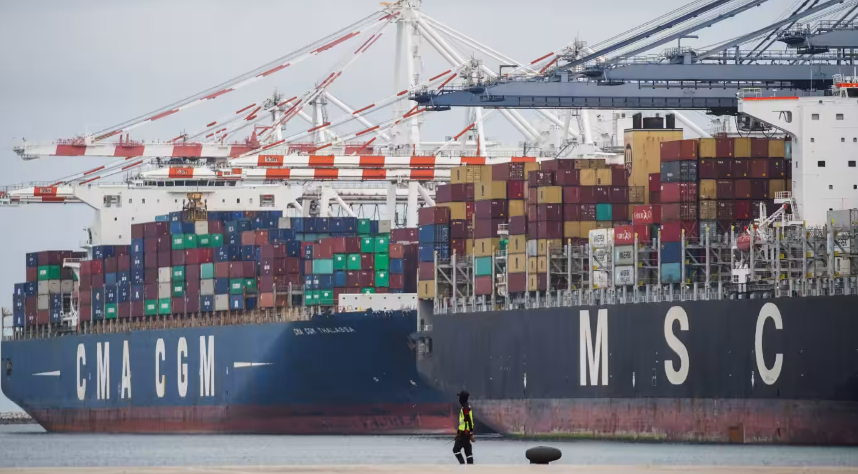
Southeast Asian exports got off to a strong start for the second half of the year, with economies such as Thailand and Malaysia in July logging their fastest growth in around two years, as overseas demand for electronics returns on the back of the ongoing upturn in the semiconductor cycle.
Despite subdued demand from the region's largest trading partner, China, goods exports to the U.S. and other Western economies in particular led the growth, according to the latest government data. Intra-ASEAN exports, which account for over 20% of the total for the regional bloc, have also picked up.
On Tuesday, Thailand reported its July exports jumped 21.8% to 938 billion baht ($25 billion) from a year ago, its highest growth rate since June 2022, driven by agricultural and related products, as well as industrial products, notably computers and electronics parts.
"The global average inflation slowdown significantly boosted consumer purchasing power, which was a key factor in this recovery," the Ministry of Commerce said in a statement. For the first seven months, Thai exports rose 3.8% in dollar terms from the same period a year ago.
In Malaysia, July exports grew 12.3% to 131.15 billion ringgit ($30 billion), the fastest pace since November 2022 and the fourth straight month of expansion. Exports to Taiwan and the U.S., which grew 55% and 30.9%, respectively, offset sluggish shipments to its largest trading partner, China, which contracted 11.4%.
Agricultural exports recorded the biggest expansion, at 32.8%, followed by manufactured goods, at 10.6%. In a research note published last week, United Overseas Bank noted that Malaysia's core electrical and electronics products, which accounted for about 40% of its exports in 2023, still have room to "recover further towards year-end."
This year's turnaround is mostly led by electronics and related sectors, on the back of an ongoing cyclical global tech upcycle. In July, the ASEAN manufacturing purchasing managers' index (PMI) marked the seventh consecutive month of improved business conditions, according to S&P Global.
"Demand conditions continued to strengthen, with growth in new orders ticking up to a 15-month high, which in turn allowed firms to raise their production solidly in July," said Maryam Baluch, an economist at S&P Global Market Intelligence.
In Thailand, analysts expect earnings at some of the largest Bangkok-listed electronics manufacturers, including Delta Electronics Thailand, a subsidiary of Taiwanese group Delta Electronics, to improve in the second half of the year, based on positive forecasts for global semiconductor, electric vehicle and smartphone sales.
New U.S. tariffs on Chinese EV-related and electronic products are also expected to benefit the companies as their sales exposure to the U.S. is larger than to China.
Meanwhile, around 60% of Malaysia's semiconductor and related companies said they expect better business performance for the July to September quarter, according to a survey last month by the Malaysia Semiconductor Industry Association, driven by demand from the consumer electronics, automotive and artificial intelligence sectors.
Other export-oriented economies such as Singapore also rebounded, with its benchmark nonoil domestic exports climbing 15.7% on the year in July, supported by the electronics and nonelectronics segments. Vietnam's estimate for the same month showed exports grew 19.1%, led by smartphones and components, as well as computers and electronics.
Analysts expect regional exports to make further gains. Goods exports from major ASEAN economies are "likely to extend" their improving growth momentum into the second half, Singaporean bank DBS said in a research note earlier this month.
In July, the ASEAN+3 Macroeconomic Research Office (AMRO), an international organization that monitors ASEAN, China, Japan and South Korea, maintained its 2024 forecast for gross domestic product growth in the Southeast Asian bloc at 4.8%, unchanged from April and an increase from the 4.2% expansion in 2023.
Despite the stronger figures, Southeast Asia's trade outperformance is not universal. Negative effects from a correction in commodity prices have weighed on Indonesia, which logged export growth of 6.5% in July from a year ago. For January to July, its exports fell 1.5% from a year earlier to $147 billion.
Governments and analysts say geopolitics and global economic growth are two other key developments to watch for in the region's trade outlook. The new U.S. administration may impose additional protectionist measures, including higher tariffs and stricter country-of-origin rules.
Yuta Egashira, a senior economist at Mizuho Research and Technologies, said he expects Southeast Asia's export growth to plateau in the second half of the year, as U.S. economic growth will likely moderate due to earlier interest rate hikes despite the tech upcycle benefiting Southeast Asia's electronics sectors.
"If the U.S economy worsens more than expected, or goes through a so-called hard landing, ASEAN exports will, in turn, likely face a downturn," he told Nikkei Asia.
Source: Nikkei Asia
Share:




<p>Time: November 2025<br /> By: WTO and International Trade Group, Legal Department – VCCI</p>
