

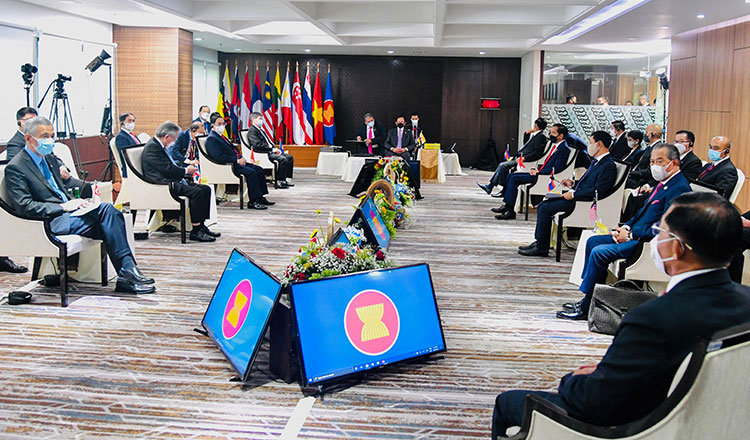
Cambodia made a strident call recently to step up both physical and digital, to promote Asean’s resilience in the post-Covid-19 recovery efforts.
In a keynote address at the 13th Asean Connectivity Symposium in Phnom Penh, Deputy Prime Minister and Minister of Foreign Affairs and International Cooperation, Prak Sokhonn, sought stronger partnerships with broader stakeholders for achieving this.
“Our future depends on our regional competitiveness, which can only come from a well-connected Asean that acts in unison,” the minister said, according to a release by the Asean Secretariat.
He further reminded that the Regional Comprehensive Economic Partnership (RCEP), the mega free trade pact that has entered into force this year, will drive Asean’s regional economy to greater heights. “There is a need to align the Master Plan on Asean Connectivity (MPAC) 2025 with other initiatives so that it can act as the nexus linking various strategies in the region for an inclusive, sustainable, and resilient Asean,” the minister said.
Asean Secretary-General Dato Lim Jock Hoi in his remarks highlighted the urgency for the region to be resilient, adaptable, and responsive to ever-changing needs. “While we continue to plan for the future, we need to build a dynamic link between thinking about the future and taking actions in the present,” he said.
He further shared that Asean Member States must work with all partners in the short, medium, and long-term, and demonstrate that the resources they invested in the region will benefit them as much as they benefit the Asean.
With the theme of ‘Enhancing Connectivity Towards an Inclusive, Sustainable and Resilient Asean Community Post 2025 Vision,’ the symposium engaged panellists from various backgrounds — from governments and think-tanks to consulting firms and multinational development banks.
The Royal Government of Cambodia was the host of the event, the first Asean Connectivity Symposium held in person after the lifting of the Covid-19 travel restrictions. It brought together over 160 participants, including Asean Connectivity Coordinating Committee (ACCC) members, representatives from the Asean Sectoral Bodies, Dialogue Partners, External Partners, multilateral organisations, and the private sector.
Against the backdrop of post-pandemic recovery, the symposium exchanged views on current issues and emerging trends as well as the challenges the Asean encounters in developing regional connectivity post-2025.
It also discussed ways to strengthen partnerships on Asean connectivity with various stakeholders, and how sustainable infrastructure, smart cities and digital innovation can shape and enhance the evolving regional network, contributing toward building an inclusive, resilient and well-connected ‘Asean Community.’
The President of the Economic Research Institute for Asean and East Asia (ERIA) Professor Hidetoshi Nishimura, in his remarks, accentuated the importance of digital connectivity in the implementation of MPAC 2025.
He made a reference to ERIA’s work on the Comprehensive Asia Development Plan (CADP) 3.0, which highlights strategies for establishing a more integrated, innovative, inclusive and sustainable economy in the Asean and East Asia by promoting physical and digital connectivity in the region. “I am highly confident that CADP 3.0 will contribute to deepening Asean’s connectivity beyond 2025,” he said.
The Asean Connectivity Symposium is an annual flagship event launched in 2010, and it continues to serve as a platform to engage stakeholders to identify potential areas of cooperation to enhance the implementation of MPAC 2025 and the wider Asean connectivity agenda.
Source: Khmer Times
Share:
<p>Time: November 2025<br /> By: WTO and International Trade Group, Legal Department – VCCI</p>
