

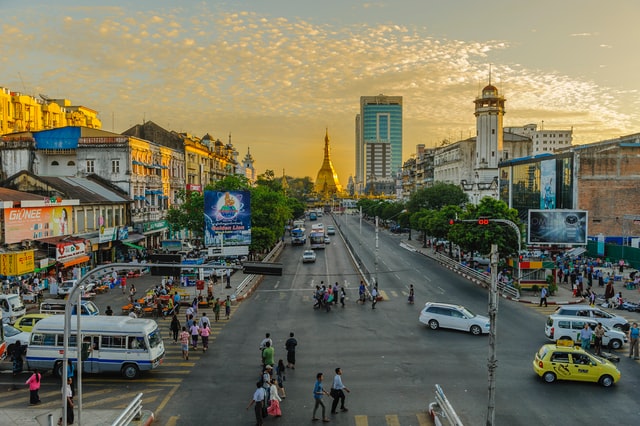
First, the textile and apparel industry plays a significant role in the economy, particularly the exports sector in Myanmar. Data from UNComtrade shows that textile and apparel accounted for nearly 69% of Myanmar’s total exports of manufactured goods in 2020, a substantial increase from only 27% in 2011. Data from the International Labor Organization (ILO) also indicates that the textile and industry (ISIC 17 & 18) employed more than 1.1 million workers in Myanmar in 2019, up from 0.69 million in 2015. Most garment workers in Myanmar are women today (around 87%).
Second, since the United States lifted the import ban on Myanmar and the EU reinstated the Everything But Arms (EBA) trade preferences in 2013, Myanmar was one of the most popular emerging apparel sourcing bases among fashion companies. Data from UNComtrade shows that from 2015 to 2019, Myanmar’s apparel exports to the world enjoyed an impressive 57% annual growth. Myanmar’s apparel exports to the EU (97% annual growth) and the United States (78% annual growth) have grown particularly fast.
From 2020 to July 2021, some of the top fashion brands that carry “Made in Myanmar” apparel items include United Colors of Benetton, Next, Only, H&M, Guess, and Jack & Jones.
There are multiple reasons why fashion companies source apparel from Myanmar:
Firstly, thanks to foreign investment (note: nearly half of Myanmar’s garment factories are foreign-owned), Myanmar specialises in making relatively higher-quality functional/technical clothing (i.e., outwear like jackets and coats. Here is an example). This is different from many other apparel-exporting countries like Bangladesh, Vietnam, and Cambodia, mostly exporting low-cost tops and bottoms.
Secondly, designated as a “least developed country” (LDC) by the World Trade Organization, Myanmar’s apparel exports enjoy duty-free market access in the EU, Japan, and South Korea. These countries also, in general, offer very liberal “single transformation” (or commonly known as cut and sew) rules of origin for qualifying apparel made in Myanmar. This explains why Myanmar’s apparel exports mostly go to the EU (56%), Japan, and South Korea (around 30%).
Thirdly, the United States is another important export market for Myanmar, accounting for 7% of the country’s total apparel exports in 2020. As a beneficiary of the US Generalized System of Preferences (GSP) program, Myanmar’s luggage exports enjoy duty-free benefits in the US market. However, the US GSP program excludes textile and apparel products, meaning Myanmar’s apparel exports to the US still are subject to the regular Most-Favored-Nation (MFN) tariff rate at around 14.3% on average in 2020.
Fourthly, the wage level in the Myanmar garment industry remains one of the lowest in the world. According to industry sources, the monthly minimum wage in Myanmar stands at around $95/month.
Third, despite years of fast growth, Myanmar still accounts for a tiny share of fashion companies’ total sourcing portfolio because of the size effect. As a country with only 55 million population, less than 500 garment factories currently operate in Myanmar compared with nearly 5,000 in Bangladesh, 6,000 in Vietnam, and over 100,000 in China. As of 2020, less than 1% of US and EU countries’ apparel imports came from Myanmar.
On the other hand, like other developing countries, Myanmar’s apparel production heavily depends on imported textile raw materials. The values of Myanmar’s apparel exports and its textile imports were highly correlated between 2013 and 2020. Further, thanks to the regional supply chain, nearly 97% of Myanmar’s textile imports came from Asia, including 83% imported from China as of 2020.
Fourth, Covid-19 has a mixed impact on Myanmar’s apparel exports. Data from UNComtrade shows that while Myanmar’s apparel exports to the world suffered an around 5.7% drop in 2020 during the pandemic, the decline was more modest than most other apparel-exporting countries in Asia, including Vietnam (-7.4%), China (-6.6%), Bangladesh (-15.1%), Cambodia (-14.3%), Indonesia (-16.1%) and India (-24.4%). Myanmar also outperformed the least developed countries (LDC) group as a whole, whose apparel exports fell by as much as 15.6% in 2020.
Myanmar’s apparel exports, in particular, had a solid performance in the US market during the pandemic. According to data from the US International Trade Commission, the value of US apparel (HTS chapters 61 and 62) imports from Myanmar went up by an impressive 20.6% in 2020 from a year ago. In contrast, the total US apparel imports fell by 23% over the same period. Notably, some of Myanmar’s top categories of apparel exports to the US surged by more than 40%, including HS 6210 (up 42.5%), HS 6108 (up 52.5%), HS 6201 (up 46.1%), and HS 6103 (up 90.5%). Data further shows that most of these increased US imports from Myanmar replaced sourcing from China and Vietnam.
A shorter lockdown period was a critical contributing factor to Myanmar’s resilience in apparel exports during Covid-19 last year. According to studies from the International Labor Organization (ILO), garment factories in Myanmar only closed from 12 to 30 April 2020 and reopened in May 2020. In comparison, garment factories in Vietnam, Bangladesh, and Cambodia, among other leading apparel exporting countries, lasted for months in 2020.
Fifth, Myanmar’s military coup that broke out in early 2021 had hurt the country’s apparel exports significantly. According to the US International Trade Commission, even though the total US apparel imports enjoyed a robust recovery in the first half of 2021 (up nearly 27%), the value of US apparel (HTS chapters 61 and 62) imports from Myanmar dropped by 0.4%. As Table 2 shows, Myanmar’s top apparel exports to the US ALL suffered a notable decline or much slower growth in 2021 than the trend BEFORE the military coup. As US fashion companies switch sourcing orders from Myanmar to other suppliers, Myanmar’s market shares fell from 0.5% in 2020 to only 0.3% in the first half of 2021.
Highly consistent with the trade data, according to the 2021 Fashion Industry Benchmarking Study, many surveyed US fashion companies expressed concerns about the military coup in Myanmar and the rising labour and social compliance risks when sourcing from the country.
Some respondents explicitly say they are leaving because of the current situation. “(We) have terminated sourcing from Myanmar due to instability,” says one respondent. Another adds: “We had orders in Myanmar that have already been moved to Cambodia. We are unlikely to place orders until the current situation is resolved.”
Notably, in another recent study, we find that apparel sourcing is not merely about “competing on price.” Instead, fashion companies give substantial weight to the factors of “political stability” and “financial stability” in their sourcing decisions today. in other words, the reputation risks matter for sourcing.
Unfortunately, the situation could get worse. The international community, including the US and the EU, is considering new sanctions against Myanmar. For example, US Congress is in the process of renewing the GSP program, which expired on 31 December 2020. However, the Office of the US Trade Representative (USTR) already suggested that even if US Congress renews the GSP program, the US government may suspend Myanmar’s GSP eligibility because of the military coup in the country.
Likewise, should Myanmar lose its EU’s EBA eligibility, its export-oriented garment sector and millions of garment workers could be among the biggest losers. Given Myanmar’s highly concentrated apparel export markets and the pandemic, it will be extremely difficult for Myanmar’s garment producers to find alternative apparel export markets in a relatively short period. For example, although China is recognised as one of the world’s largest and fastest-growing emerging import markets, only 1.4% of Myanmar’s apparel exports went to China in 2020.
Source: Just Style
Share:
<p>Time: November 2025<br /> By: WTO and International Trade Group, Legal Department – VCCI</p>
