

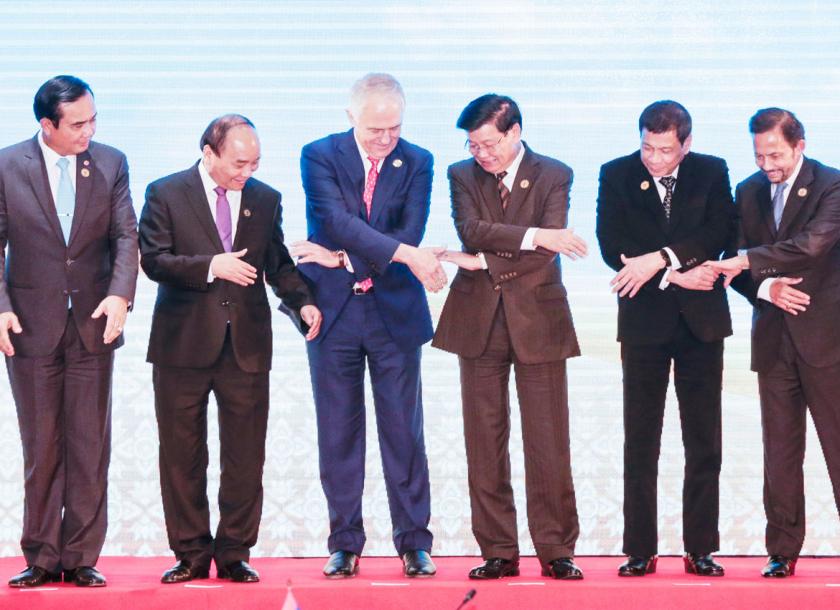
When Australia looks to the north, what does it see? Southeast Asia, of course. But the region is no longer the geographic landmass in its front yard comprised of 10 countries governed by political systems and cultural values different than its own. From this past weekend onward, Southeast Asian countries, each with a unique domestic dynamic, will become the nexus of Australian foreign policy.
Collectively, the 645-million-strong ASEAN community can greatly benefit Australia, economically and politically. The summit between their leaders in Sydney on Saturday and Sunday effectively put ASEAN at the heart of Australian strategic planning as never before. Judging from the year-long preparations for the special summit, Canberra is deadly serious about riding the rollercoaster with ASEAN. A full week of activities related to ASEAN in major cities ahead of the summit were aimed at changing the perception of ASEAN sceptics and promoting awareness and understanding of ASEAN-Australian relations.
This kind of “cool-headed” assessment does not come easy. It has taken a long time for Australian policymakers to come to terms with themselves and the new reality of Southeast Asia. Some still think ASEAN is just a lot of empty talk and toothless gestures, and is comprised of countries ruled by authoritarian regimes. But others have a more positive picture of the group.
For the time being, the government of Prime Minister Malcolm Turnbull is going all out to push ASEAN-Australia ties to the next level. The websites of the Canberra government are packed with information and data portraying Southeast Asia as a huge market for Australian companies, with two-way trade of more than US$100 billion (K1.34 trillion), exceeding trade with the US and Japan.
In short, more than 12,000 Australian firms are making money in ASEAN. With a combined GDP of more than $2.4 trillion, which translates into immense economic potential, it represents a vast opportunity for Australia. But will Australia’s leaders be resilient enough to engage Southeast Asia’s leaders and their peoples?
After decades of ambivalence, Australia is no longer shy about approaching Southeast Asia on its own merits. This attitude harks back to the good old days of 1983 to 1996, when Australia was led by prime minister Bob Hawke and his successor Paul Keating.
Hawke’s quick decision during his visit to Thailand in 1989 to fund the first bridge linking Thailand and Laos across the mighty lower Mekong River was considered one of the best foreign policy decisions with a low price tag that Canberra ever made. The bridge has now turned landlocked Laos into land-linked Laos and a little tiger, with nearly 10 percent annual growth. Indeed, the proliferation and prevalence of friendship bridges would become a connectivity and logistics tool in this part of the world. It is not wrong to say that three decades ago, Australia captured ASEAN’s two most important priorities: connectivity and bridging the gap between its members’ economies.
With major international shifts today outside Australia’s control and choosing, Canberra realises that new pragmatic views and policies toward ASEAN are urgently needed. Indeed, of all ASEAN’s 10 dialogue partners, Australia is one of the most active and innovative. After all, then-Australian foreign minister Sir Paul Hasluck quickly welcomed ASEAN the day after it was founded on August 8, 1967, and Australia has continued to engage with the group throughout their four decades of relations. One thing that has never changed: The stability and prosperity of Southeast Asia is pivotal to Australia’s overall well-being.
ASEAN remembers well those times when Canberra was the key driver of economic and security structures that are still in place today. The Asia-Pacific Economic Cooperation and the ASEAN Regional Forum are two of those legacies. Australian diplomacy helped end the 13-year Cambodian conflict and brought Indochina to the economic fore. At the time, ASEAN welcomed Australia, because its leaders showed an authentic desire to act for peace and stability in the region independent of the other great powers.
In retrospect, it could be argued that Australia became the first dialogue partner of ASEAN during the Hawke-Keating era because of the quality and intensity of its engagement. Both men knew that ASEAN was an important part of East Asia and the Indo-Pacific region. But support among Australia’s politicians and public at the time was weak due to a lack of understanding and awareness of Southeast Asia and its diversity. The situation today is much improved. The common fear that Southeast Asians would cross the Timor Sea and gobble up the Lucky Country has subsided.
ASEAN countries currently host about 860,000 Australians, and one million of Australia’s 24 million people have ASEAN roots. These latter have become prominent and enterprising citizens, causing no trouble, as many locals had feared. Most of the 100,000 Southeast Asian students in Australia choose to return to their homelands after graduation or internships.
Under Turnbull, Australia now perceives ASEAN as a true strategic partner and a moral force that can shape regional and international politics. Obviously, Canberra could more easily identify with ASEAN after it adopted the ASEAN Charter in 2008, making it a rules-based entity. But the regional group’s failure to come up with a collective position on the verdict of the Permanent Court of Arbitration on the South China Sea conflict two years ago was a huge disappointment. Australia, the US and Japan, who were at the forefront of the decision, issued a joint statement strongly supporting the verdict, much to the chagrin of ASEAN.
In the coming months, the crisis in Myanmar’s Rakhine State and political developments in Cambodia will test the ability of Australian policymakers to manage the growing complexity of regional issues. For the time being, Canberra has made the right choice by not following the US and EU on these matters. This kind of strategic patience is necessary when the global situation is filled with uncertainty and wars of attrition. Australia and ASEAN can easily deepen cooperation to handle other challenges, such as counter-terrorism, cybersecurity, maritime cooperation, human trafficking and disaster management.
When all is said and done, ASEAN will certainly respond in kind to Australia’s genuine assessment of their mutual interests without the meddling of other major powers. As surely as the sun rises in the morning, Australia will be the first dialogue partner to join ASEAN as a full member.
While it is true that there is no consensus yet in ASEAN to admit Australia, the group’s attitude could easily shift if Australia develops an authentic voice and truly regional-based ties.
By the time ASEAN-Australian ties reach their golden anniversary in 2024, Australia could fit snugly in the middle seat of the ASEAN rollercoaster.
Source: Bangkok Post
Share:
<p>Time: November 2025<br /> By: WTO and International Trade Group, Legal Department – VCCI</p>
