

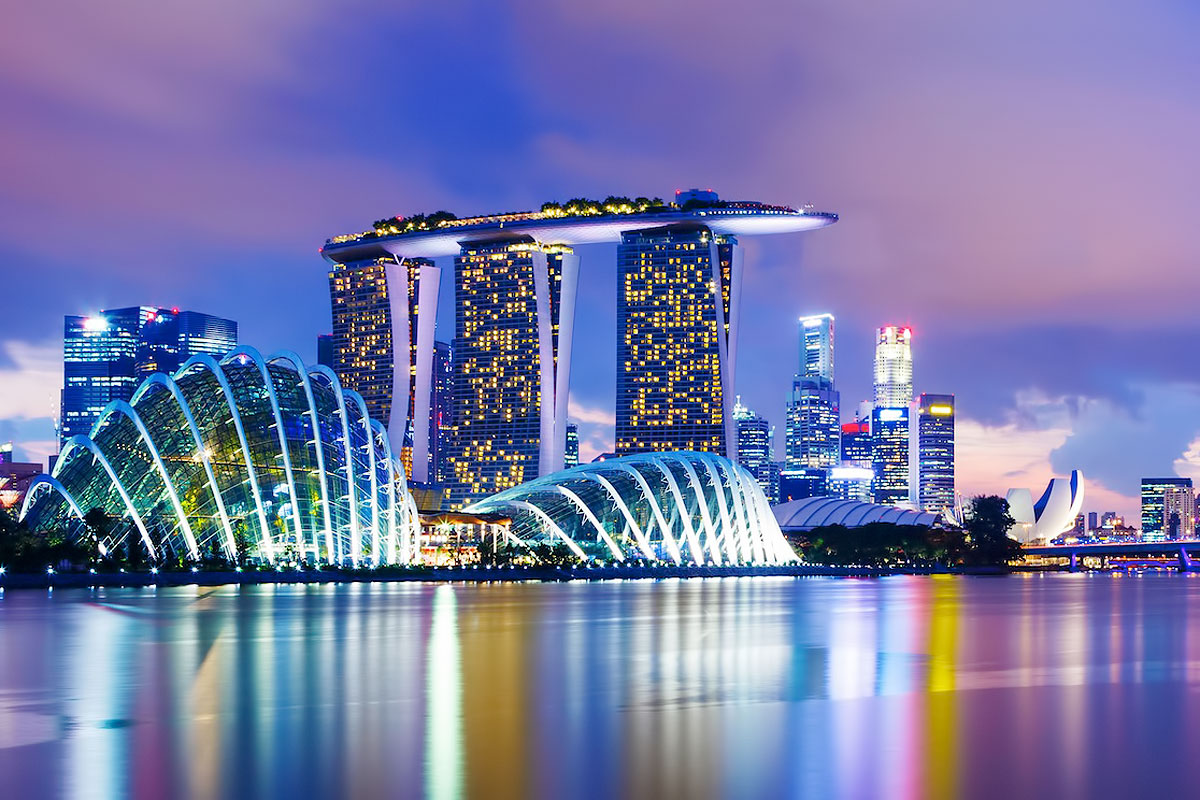
As a financial center and startup hub in Southeast Asia, Singapore has announced a spate of ambitious development projects in 2017, seeking to utilize AI (artificial intelligence), FinTech, autonomous driving and other digital technologies to drive industrial transformation and generate economic growth momentum for the next 5-15 years.
Banking institutions ANZ, DBS and UBS have released Singapore's economic growth projections at 4%, 3% and 2.7% respectively for 2018, but the country has set sights on galvanizing its longer-term economic development by implementing such aggressive projects as Smart Nation 2025, Regional FinTech Hub, AI Singapore and Smart Mobility 2030.
Though a small city state with a population of only 5.6 million and land space of 719 square kilometers, Singapore has a strong role to play among ASEAN (Association of Southeast Asian Nations) members and has been actively extending its influences to regional developments.
During its one-year rotating chairmanship of ASEAN in 2018, Singapore will move to realize some goals set in the ASEAN Economic Community Blueprint 2025, such as simplifying trade regulations within the region, enhancing digital connections, enabling enterprises to more easily access new markets and overseas customers, and promoting the development of e-commerce and digital economy, according to Lim Hng Kiang, Singapore's minister of trade and industry.
Furthermore, Singapore will also step up implementing ASEAN trade facilitation measures, including the establishment of self-certification regime and ASEAN Single Window to help enterprises in the area boost their operating efficiencies and reduce their regulatory compliance costs and time cost needed from shipments to retail shelves.
Among ASEAN member states, Singapore, Malaysia and Vietnam have joined both Regional Comprehensive Economic Partnership (RCEP) orchestrated by China and Trans-Pacific Partnership (TPP) originally initiated by the US. Despite the US withdrawing from TPP, the other 11 target members have decided to carry on the trade scheme under the name of Comprehensive and Progressive TPP (CPTPP). In response, China has called for all the RCEP-related talks to be completed by the end of 2018. This will let Singapore play a crucial role in pushing for Asia-Pacific regional integration.
Source: Digitimes
Share:


<p>Time: November 2025<br /> By: WTO and International Trade Group, Legal Department – VCCI</p>
