

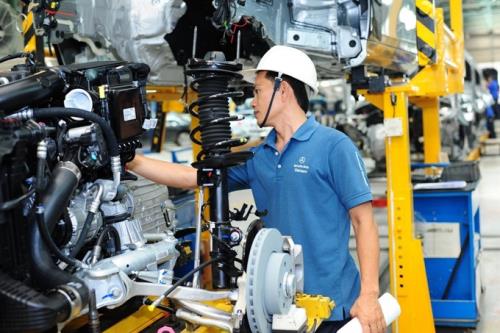
Japan plans to work with Southeast Asian countries to boost productivity and modernize trade systems, hoping to encourage them to pursue more ambitious goals for the Regional Comprehensive Economic Partnership, or RCEP.
Three-pronged strategy
Hiroshige Seko, Japan's minister of economy, trade and industry, will propose a new framework for economic cooperation Saturday at a meeting of Association of Southeast Asian Nations finance ministers in Manila. The partnership would center on promoting innovation, supporting small businesses and developing rules governing trade and investment.
Japanese companies are working more closely with ASEAN members on cutting-edge fields such as artificial intelligence, the "internet of things" and robots to increase the productivity of local businesses.
Hitachi High-Technologies will begin as early as this fall a trial run of such technology at a plant in Thailand. The Hitachi subsidiary will install sensors and cameras enabling the manufacturer to quickly adjust production and shipping according to customer needs. The system will allow for remote technical support from Japan as well. Separately, Denso will introduce AI-equipped robots and automated production lines at factories run by Thai companies.
Another aim is to narrow the widening gap between the big businesses that have benefited the most from the region's economic growth and their smaller counterparts. Starting this fiscal year, Japan's industry ministry will match ASEAN companies looking to expand abroad with Japanese partners to help improve their profitability.
Japanese companies including IHI, Nidec and Nissan Motor are also delivering lectures on Japanese manufacturing methods in collaboration with universities in the Philippines, Indonesia, Thailand and elsewhere.
Japan also hopes to assist with necessary infrastructure for trade, an area where ASEAN lags behind more advanced economies. The region's customs systems have not kept up with rising freight volumes, leading to processing delays. Japan plans to help install electronic systems to speed up customs procedures, as well as advise countries on establishing legal frameworks for e-commerce.
Building confidence
Tokyo's aim is partly to strengthen its position in negotiations on RCEP, a 16-member trade pact that includes Japan and the 10 ASEAN countries along with China and South Korea.
Japan is looking for an ambitious deal along the lines of the Trans-Pacific Partnership, the fate of which is up in the air after the U.S. bowed out. This puts it at odds with China and others seeking less liberalization in hopes of protecting domestic industry. RCEP members are expected to officially give up on signing an agreement this year at a ministerial meeting Sunday, instead working toward a deal in 2018 or later.
Emerging countries that have not yet made up their minds will be key to determining the pact's direction. Many are reluctant to go too far with scrapping tariffs lest they put less-competitive domestic companies at a disadvantage. Ensuring high standards for customs systems and intellectual property rules is a concern for Tokyo as well.
Japan hopes to ease these countries' fears through collaboration on productivity-boosting innovations and trade rules, paving the way for a high-quality agreement. But getting results likely will take time, leaving it unclear whether this effort will help in the negotiations.
Source: Nikkei Asean Review
Share:




<p>Time: November 2025<br /> By: WTO and International Trade Group, Legal Department – VCCI</p>
