

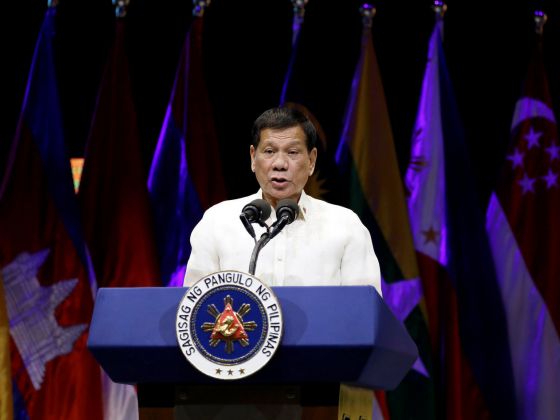
Philippine President Rodrigo Duterte yesterday took a swipe at the Trump administration’s retreat from a major free trade deal, joining Asian nations at a forum this week in criticising rising protectionism.
Until recently, China and the United States were both pushing sweeping free trade deals that excluded each other. But shortly after taking office in January, US President Donald Trump withdrew from the Trans-Pacific Partnership (TPP) trade pact, which he described as a “job killer”.
The move delivered a hammer blow to the 11 other nations who spent seven years negotiating what was billed as the world’s largest trade deal.
During a speech celebrating the 50th anniversary of the Association of South-east Asian Nations (Asean) in Manila, Mr Duterte gave his backing to a planned trade pact backed by China known as the Regional Comprehensive Economic Partnership (RCEP).
“Asean has a bigger stake than any part of the world in standing up against protectionism and securing the rules of the game in the international trade,” he told delegates.
RCEP, he said, “will provide further impetus to our efforts”, adding he hoped negotiations on the Beijing-led deal “should conclude swiftly”.
Manila, as chairman for Asean, has committed to fast track the RCEP. In April, Trade Secretary Ramon Lopez said the Philippines will push for the “substantial conclusion” of the RCEP that will expand the Asean market from 600 million people to 3.5 billion by year-end.
Mr Dueterte yesterday added a jab over TPP’s collapse.
“(I’m) reminded that the Trans-Pacific, it was a dream, is no longer there,” he said.
Before Mr Trump’s withdrawal, TPP would have covered around 40 per cent of the global economy.
It went further than most existing free trade pacts, with labour laws, environmental protections and intellectual property rights touted by backers as a new gold standard for global trade.
The deal, which excluded China, was also seen as a way to counter Beijing’s regional economic dominance.
The remaining TPP signatories have agreed to pursue the trade deal without Washington.
Malaysian Minister of Trade and Industry Mustapa Mohamed has earlier said that negotiations on reviving the TPP are likely to be concluded in November during the Asia-Pacific Economic Cooperation (Apec) meeting in Manila.
In response to TPP, Beijing has been pushing the RCEP, a more modest deal that prescribes lower and more limited regulatory standards.
The pact would group China with the 10 Asean members plus India, Japan, South Korea, Australia and New Zealand.
Throughout the security forum of regional foreign ministers that ended yesterday, multiple countries voiced specific concerns about rising protectionism, including Japan, South Korea, China and the 10-member Asean grouping.
“Anti-globalisation sentiments and protectionist threats, to just name a few, are gaining force in many parts of the world, fuelling global economic and political uncertainty,” South Korean Foreign Minister Kang Kyung-Wha said during a meeting with her Japanese and Chinese counterparts on Sunday. AFP
Source: Today Online
Share:


<p>Time: November 2025<br /> By: WTO and International Trade Group, Legal Department – VCCI</p>
