

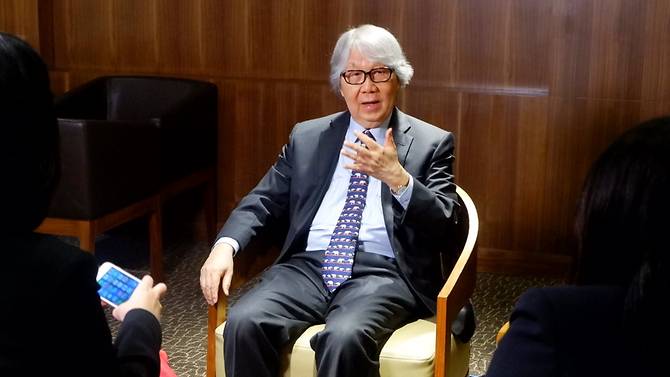
As the Association of Southeast Asian Nations (ASEAN) marks its 50th anniversary this year, the biggest challenge for the regional group moving forward will be for it to stay united, said Singapore's Ambassador-at-Large Tommy Koh.
He was speaking to Channel NewsAsia in the Philippine capital Manila where day-long celebrations took place on Tuesday (Aug 8) to mark the milestone.
Professor Koh was presented a commemorative plaque on behalf of the late former Singapore foreign minister S Rajaratnam, who was among the five founding leaders of ASEAN that signed the agreement on Aug 8, 1967 marking the formation of the regional bloc.
The others were the late former Malaysian deputy prime minister Tun Abdul Razak, and late former foreign ministers Aam Malik of Indonesia, Narciso Ramos of Philippines and Thanat Khoman of Thailand.
THE SECRET OF ASEAN’S SUCCESS
Professor Koh, who was a close friend of Mr Rajaratnam and a trustee of his estate, said one of the secrets of ASEAN’s success was the friendship of the five founding fathers.
“They were on first name terms, they enjoyed seeing each other, they joked at each other's expense,” said Professor Koh, who also noted that the environment in 1967 had not been conducive.
“I was a witness and saw how this comradeship, the spirit of unity, the belief that this is a very important institution they’re building. They’ve been vindicated 50 years later.”
When asked about what challenges he foresees ASEAN may face moving forward, Professor Koh said staying united will be key.
“I think as the major powers compete more intensely with one another for influence in the region, we will come under competing pressures,” noted Professor Koh.
He said: “So how can ASEAN remain independent and neutral? Will we have the wisdom to avoid being sucked into the orbit of any one major power and to remain neutral and independent? If we can, then we will continue to be a valued convenor and channel of the regional institutions and forums.
"But if we lose that and become allied to one or the other or we break up in disunity, then I think that will be the beginning of the end of ASEAN.
ECONOMIC AND POLITICAL RELEVANCE
ASEAN is a grouping that has both economic and political relevance, said Professor Koh.
Currently, the 10 ASEAN states together are ranked as the sixth largest economy in the world and it is expected to become the fourth largest, if growth continues at five per cent per annum.
“You can’t ignore the fourth largest economy in the world,” he pointed out.
Politically, he added that ASEAN’s relevance is its ability to bring different countries to the discussion table - whether it's at the ASEAN Regional Forum, East Asia Summit or its plus one meetings.
For example, when asked about pressure from the US at the recent ASEAN meetings to downgrade diplomatic exchanges with North Korea, Professor Koh said that ASEAN’s way of engagement has been proven to work.
“ASEAN's policy and experience is that isolating another country and condemning them, imposing sanctions on them will not work,” he noted.
“In the case of Myanmar, the western world isolated Myanmar, imposed sanctions on them - the ASEAN countries didn't do that. We brought them into the family, we tried to influence them in a very gentle Asian way, and the Myanmar leadership, the military leadership, decided on their own volition - not because of external pressure - to develop their own roadmap to democracy.”
LOOKING AHEAD
As for the next five to 10 years, Ambassador Koh said while this will be a critical period, ASEAN has survived many tests before.
“Individually, every ASEAN country is a sovereign and independent country and if they choose to be close to one major power than the other, that’s fine," he said. "But when we meet as 10 they should remember Mr Rajaratnam’s message that as a member of ASEAN, I may have to modify my national policies and preferences for the sake of the greater good."
“We’ve done it for 50 years and I think if we are wise we will succeed in the next five to 10 years.”
Source: Channel New Asia
Share:




<p>Time: November 2025<br /> By: WTO and International Trade Group, Legal Department – VCCI</p>
