

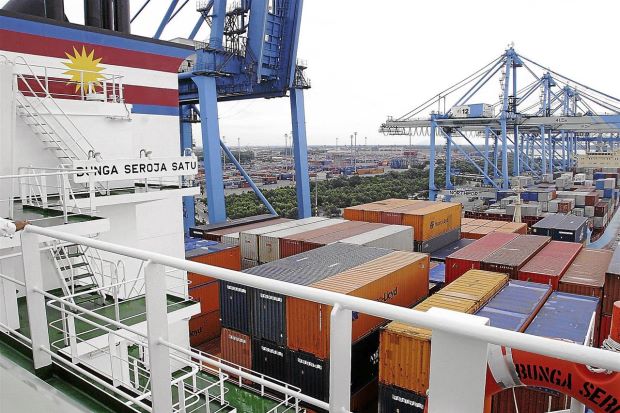
A new Deutsche Bank report examines ASEAN's progress towards realising the 2025 Economic Community Vision - of a more integrated, innovative and competitive region.
The Deutsche Bank released the report, "Reimagining ASEAN to 2025", on Thursday. The removal of trade barriers, supportive national and regional policies, and investment in digitalisation are highlighted as key areas of focus for the region moving forward, according to a statement.
"The 2025 ASEAN Economic Community (AEC) blueprint, and the corresponding 2025 ASEAN Capital Markets Vision have already set an ambitious vision for ASEAN's future," explains Boon-Hiong Chan, Deutsche Bank's GTB Head of Market Advocacy APAC, and lead of the "Reimagining ASEAN" report.
"But how can ASEAN ensure the delivery of this vision? This is the complex question our report - by bringing together the likes of Dr Allan Bollard, Executive Director of the Asia Pacific Economic Cooperation (APEC), Dr Denis Hew, Director of the APEC Policy Support Unit, Ambassador Michael Michalak, Senior Vice President and Regional Managing Director of the US-ASEAN Business Council, and Chris Humphrey, Executive Director at the EU-ASEAN Business Council - seeks to answer."
The report suggests that, on the eve of its 50th anniversary, ASEAN is in a strong position. In fact, Deutsche Bank predicts Indonesia, the Philippines, and Vietnam will post at least 5.0pc growth in 2017 and 2018. But, for a highly prosperous, deeply integrated ASEAN to materialise - ongoing efforts to advance critical reforms have to be intensified within the next decade.
Commenting in the report, Dr Allan Bollard, Executive Director of the Asia Pacific Economic Co-operation (APEC) Secretariat emphasises that, if the AEC vision is to become a reality, "governments must make sure there are no unnecessary barriers restricting integration - neither tariffs, nor unnecessary regulations. While there has been an understandable tendency for governments to hesitate before extensive regulatory reform, it is important that they do the cost benefit analysis and push through change where possible and appropriate".
Chris Humphrey, Executive Director at the EU-ASEAN Business Council expands on this: moving forwards, "the key milestones for the AEC project will be in areas such as the full operationalisation of the ASEAN Single Window for customs clearances; the establishment of a firm and meaningful process for the removal of Non-Tariff Barriers; and the full implementation of trade facilitation measures, including the WTO Trade Facilitation Agreement"
Crucially, the report highlights the fundamental role that digital technology can play in facilitating integration and sustainable economic growth moving forwards.
As Ambassador Michael Michalak puts it: "The digital economy is the future - it doesn't matter if you are selling papers in the street, testing your soil acidity, or trying to pay 5,000 staff - if harnessed effectively, digital technology can provide benefits for all".
However, the report also warns that if this opportunity is to be realised, digitalisation must be positioned as a central pillar in the AEC vision of a single economic market. Digital technology can bring a number of opportunities, but without sufficient regional cooperation it can also be seen as a competitive threat and lead to divisive outcomes.
Source: The Financial Express
Share:




<p>Time: November 2025<br /> By: WTO and International Trade Group, Legal Department – VCCI</p>
