

The remaining members of the Trans-Pacific Partnership trade deal showed at least some level of unity in a statement May 21, but the outlook for a "TPP 11" version of the trade pact after the U.S. bailed on the deal looks hazy as gaps remain on key issues.
Ministers of the 11 countries met in Vietnam on the sidelines of the meeting of the Asia-Pacific Economic Cooperation forum, and compiled a statement that emphasized the expected economic benefits of the 12-nation pact reached in October 2015. The 11 countries look to conclude talks by November on an alternative arrangement without the U.S. to implement the agreement quickly, the statement said.
The 12-nation pact requires ratification by at least six members accounting for 85% of the membership's aggregate gross domestic product. The absence of either Japan or the U.S. -- the two biggest economies in the deal -- would require a fresh agreement.
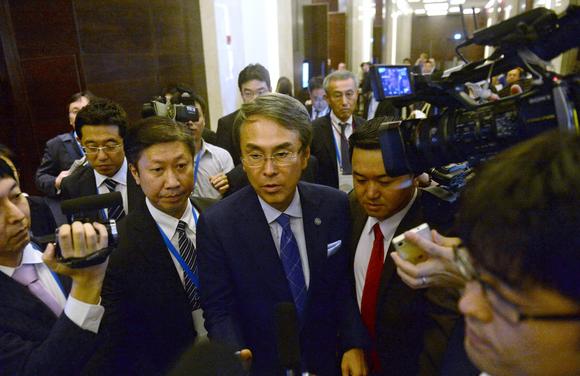
The 11 countries' commitment has been confirmed, Nobuteru Ishihara, Japan's economic and fiscal policy minister, told reporters in Hanoi after the meeting. He also revealed that chief negotiators will meet in Japan in July, adding that Tokyo would serve as a bridge to lure Washington back for talks -- though the U.S. is unlikely to return easily.
Washington will not revise its position on leaving the TPP, U.S. Trade Representative Robert Lighthizer said at a joint news conference after the APEC trade ministers meeting. Making his first international appearance since taking office earlier this month, Lighthizer said, "The United States pulled out of the TPP and it's not going to change that decision. The president made a decision, that I certainly agree with, that bilateral negotiations are better for the United States than multilateral negotiations."
Japan is seeking to maintain the outline of the 12-nation agreement, hoping to enact it with the 11 remaining members. New Zealand and Australia are clearly on board. But Canada and Mexico have been muted in their response, perhaps out of concern that stating their stance could affect the upcoming renegotiation of the North American Free Trade Agreement.
Asian countries such as Vietnam, which had agreed to revamp regulations in exchange for a more open American market, may demand revisions to the deal. Malaysia continues to observe quietly. Chile and Peru have also been ambivalent.
Ishihara said, "The countries have different opinions, but Japan will take the lead to make sure the deal does not fall apart."
Sunday's statement still cited efforts to bring the U.S. back on board, along with opening the door to other countries that share the ideals of the pact.
The following day, ministers from 16 Asia-Pacific countries met in Hanoi and agreed to conclude a regional free trade deal quickly.
Source: Nikkei
Share:


<p>Time: November 2025<br /> By: WTO and International Trade Group, Legal Department – VCCI</p>
