

The city-state has agreed to explore nuclear ties with the Philippines, as Indonesian doubts cloud its plans to import green power.
Singapore will use its 2027 Asean chairmanship to push for common rules on cross-border power trade, after warning that unclear regulation is holding back regional grid investment.
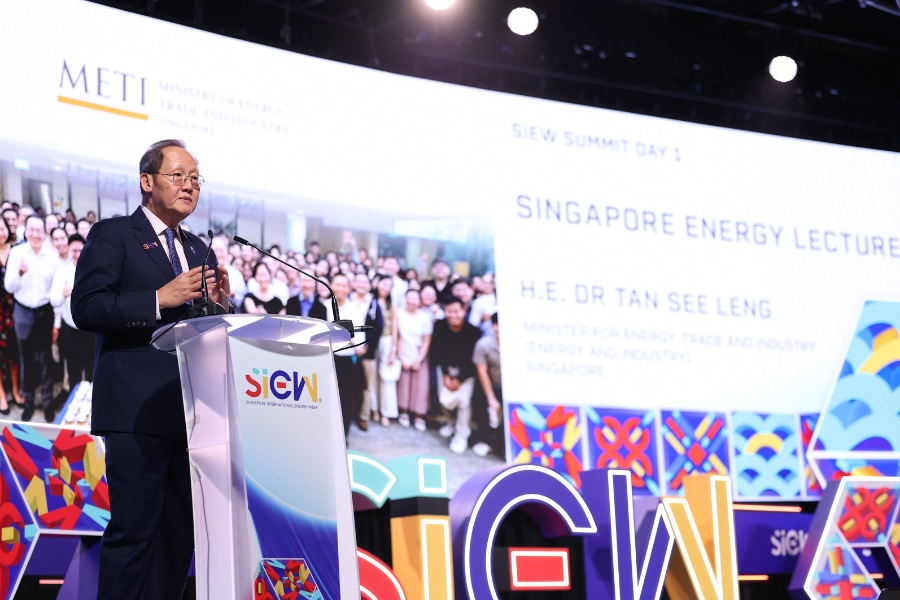
Tan See Leng, the minister for energy, trade and industry, called for “clear and predictable regulatory frameworks” to advance cross-border electricity trade.
“Without such frameworks, it will be challenging to attract investments to realise the full potential of the Asean power grid,” said Tan at last week’s Singapore International Energy Week (SIEW).
As the incoming Asean chair, Singapore plans to establish a regional submarine power cable framework and shared guidelines around cross-border wheeling charges, the fee imposed for transmitting electricity through another country’s grid.
Gan Siow Huang, a minister of state for energy, trade and industry, told SIEW participants that the Asean energy ministers expressed support for the guidelines last month.
The second phase of Singapore’s joint feasibility study with the US on energy connectivity in Southeast Asia found that transnational projects currently face financing challenges due to long development timelines, complicated permitting processes, marine and technical risk and revenue uncertainty.
One recommendation from the preliminary findings shared at SIEW, was for projects to use a shared ownership model to allocate costs, instead of geographically splitting the ownership and financing of the project.
Nuclear ties with the Philippines
Tan also announced at the annual event that the city-state has signed a letter of intent with the Philippines to explore collaborations in nuclear energy.
Under the pact, both nations have committed to deepen understanding on advanced nuclear technologies, human resource development, nuclear waste management, civil liability frameworks, among others, Felix William B Fuentebella, undersecretary of energy of the Philippines, told Green Central Banking on the sidelines of the summit.
“As Singapore assumes the Asean chairmanship next year in 2027, we will work to deepen regional collaboration and discourse, including through the Asean Network of Regulatory Bodies on Atomic Energy and Nuclear Energy Cooperation subsector network,” said Tan.
“There remains significant scope for close cooperation to ensure that any deployment of nuclear energy is done safely and securely.”
To date, the Philippines is the only Asean member country with a nuclear plant, though it was mothballed in 1986 after president Ferdinand Marcos Sr was overthrown from power. Under the Marcos Jr administration, the Philippines is revisiting plans to revive the plant and add at least 1,200 megawatt (MW) of nuclear power to its energy mix by 2032.
Other countries in the region have started including nuclear energy in their climate targets in the past few years.
Indonesia plans to add up to 10 gigawatt (GW) of nuclear energy by 2040, Vietnam has revived its nuclear programme with the aim of building its first plant by 2031, Thailand is targeting 600MW of nuclear energy by 2037, while Singapore is studying the deployment of nuclear to power up to 10% of its power needs by 2050.
Securing green energy imports
Singapore, which has limited domestic renewables potential, has also been pursuing cross-border electricity imports to meet its climate targets.
The city-state aims to import 6GW of low-carbon electricity by 2035 to meet roughly one-third of its energy needs. Over half of its green power imports are set to come from Indonesia, but the country has recently cast doubt on these deals amid haze-fuelled tensions.
While Indonesia withholds support for wider regional power grid developments over what it deems as unfair export terms,
In the past year, Singapore has commissioned and co-led various studies to help build the Asean power grid, which was first mooted over two decades ago.
Last month, Singapore and the World Bank launched the Asean Power Grid Mobilisation Partnership to address regulatory and bankability hurdles.
The International Energy Agency (IEA) regional cooperation centre in Singapore has also recently published its Asean power grid implementation framework, which urges the bloc to pilot a cost-benefit analysis methodology to consider the regional benefits of interconnector development.
Singapore and Malaysia have also established a joint working group to harmonise approaches to tracking and accounting of renewable energy certificates (RECs) from cross-border energy projects.
RECs, which represent 1 megawatt-hour (MWh) of renewable energy, can be used to offset a company’s emissions arising from its electricity purchases.
In line with international practices, Singapore recently amended its standards to recognise RECs from approved cross-border electricity import projects, where the electricity is physically sold together with the green certificates they represent.
At SIEW, the country’s Energy Market Authority revealed it had granted conditional approval to state-owned Sembcorp Utilities to import a total of 1.3GW of low-carbon electricity, including solar power from Malaysia.
In August, two projects were given a conditional nod to collectively import 900MW of solar power from Malaysia. Marine subsea surveys for a second interconnection with Malaysia, which could add up to 2GW of capacity by 2030 alongside the existing 1GW link, also began last month.
Source: Green Central Banking
Share:

<p>Time: November 2025<br /> By: WTO and International Trade Group, Legal Department – VCCI</p>
