

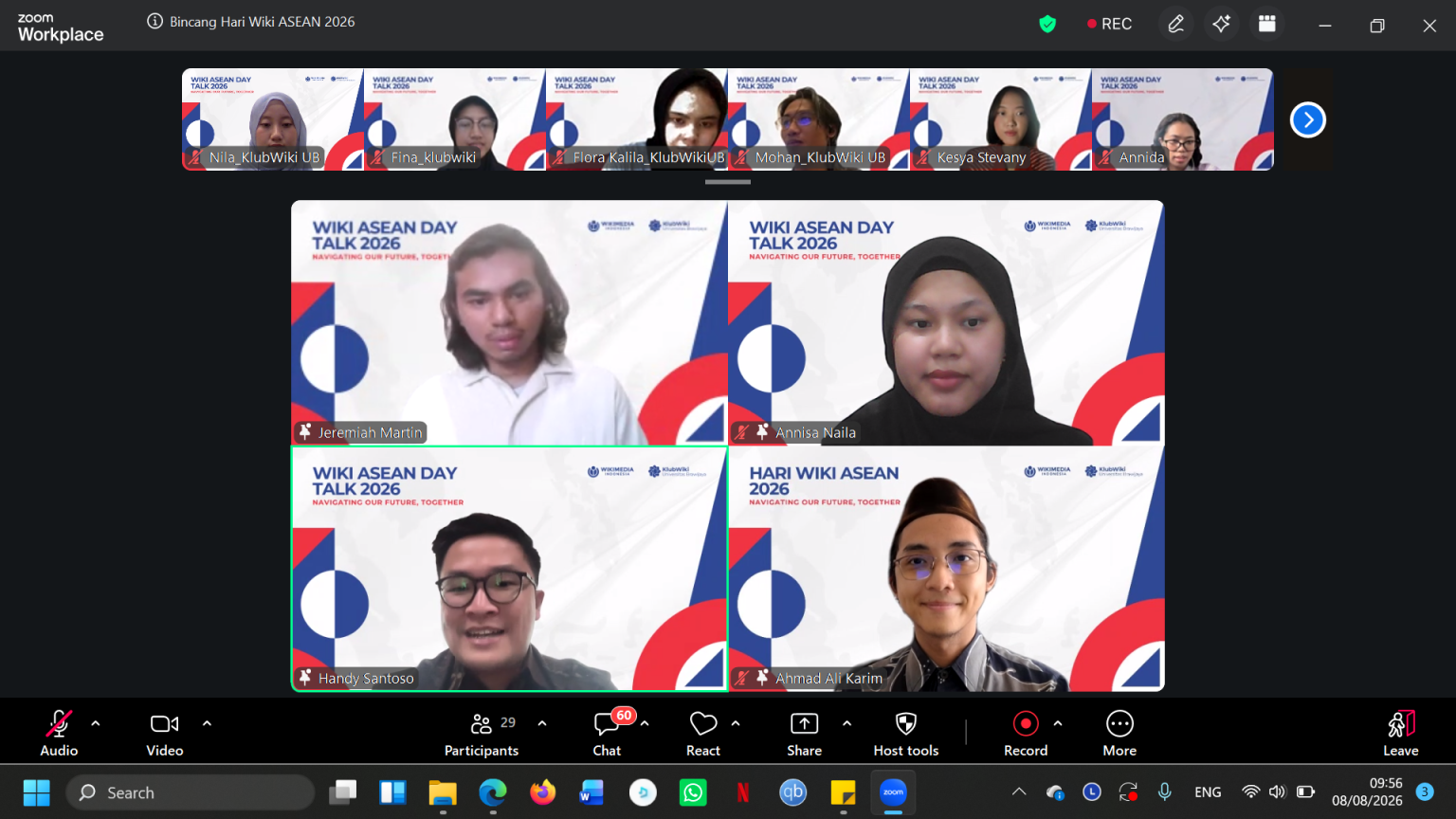
Saturday, August 8th 2026. Coinciding with ASEAN Day, KlubWiki Universitas Brawijaya held the online event Wiki ASEAN Day Talk 2026 via Zoom. This talkshow was a part of Wiki ASEAN Day 2026, a regional initiative by KlubWiki UB in support of the main theme to the 2026 ASEAN Summit, “Navigating Our Future, Together”. Wiki ASEAN Day 2026 focuses on youth empowerment, in line with the People Empowerment pillar of the ASEAN Community Vision 2045, ASEAN Socio-Cultural Community sphere.The event was opened by MC Kesya Stevany Santoso and led by discussion moderator Jeremiah Martin, both members of KlubWiki Universitas Brawijaya.
Kanyadibya Cendana Prasetyo, advisor to KlubWiki Universitas Brawijaya and lecturer of the International Relations programme at Brawijaya University, expressed how Wiki ASEAN Day is an important presence in raising awareness and creating a sense of belonging towards ASEAN among Wikimedia contributors across Southeast Asia. She stated, “I think Wiki ASEAN Day is a significant event in promoting ASEAN and nurturing a sense of belonging as fellow ASEAN citizens among Wikimedia contributors in Southeast Asia.”
In addition, this discussion was designed as a forum to explore the role of youth in ASEAN development, but it also serves as part of an effort to build a cross-national open knowledge network. Annida Nur Fattiya, Project Leader of Wiki ASEAN Day 2026, explained that “This program is designed to bring together contributors from various ASEAN countries so they can share experiences, collaborate, and preserve cultural diversity through open knowledge, while celebrating a shared identity and a sense of pride in being part of ASEAN.”
The discussion featured three speakers who actively contribute to their communities in Southeast Asia. The first speaker was Handy Santoso, Manager of ASEAN, Customs, and Trade Facilitation at the U.S.-ASEAN Business Council, who previously worked at the ASEAN Secretariat and is active as a volunteer with the ASEAN Youth Organization (AYO). The second speaker, Ahmad Ali Karim, is the External Relations Officer at Wikimedia Malaysia; he also serves as the Asia-Pacific Coordinator at the Regional Center of Expertise (RCE), which is affiliated with the United Nations University, and is one of the founders of the ESEAP Youth Group, which was launched just three months earlier at the ESEAP Conference in Taiwan. Finally, the third speaker, Annisa Naila, is a member of KlubWiki Universitas Brawijaya who recently completed her bachelor’s degree in International Relations at UB and is a recipient of the IISMA student exchange scholarship in Croatia.
The discussion centered on the importance of youth in ASEAN’s development. “We are advocating for placing ‘people’ at the center of development in ASEAN,” Handy said in response to the moderator’s question about the urgency of youth engagement. He emphasized that empowerment means equipping human resources with relevant skills so they can contribute positively to the ASEAN community, and that youth are not merely beneficiaries of policies but active agents who help shape the region’s future. Ahmad added that grassroots movements such as Wikimedia clubs can serve as a driving force for youth empowerment, as the values of openness and mutual respect within the Wikimedia movement align with the principles of the ASEAN Way, including the spirit of non-intervention and respect among member states. He also shared a concrete example of Wikimedia’s inclusivity: a member of the Malay Wikipedia who became an administrator at the age of 13, proving that age is no barrier to contributing.
From the perspective of the younger generation, Annisa believes that the Wikimedia platform provides a safe space for anyone, regardless of age, to share perspectives and shape their identity as part of the ASEAN community. She also shared her cross-cultural experiences during the IISMA program in Croatia as an example of how finding shared values can strengthen intercultural relationships. The discussion then addressed several challenges facing the Wikimedia movement in Southeast Asia, such as the stigma surrounding Wikipedia in educational settings, apathy among some young people, and the lack of accessibility and promotion of grassroots communities at the regional level. The solution, according to the speakers, is to start with small steps, develop programs that resonate with the values of the younger generation, and continue to expand networks across countries and communities.
At the end of the discussion, the three speakers shared their hopes for the region’s future. Handy hopes that the younger generation in ASEAN will no longer view themselves solely as citizens of their respective countries, but rather as part of one large ASEAN community—so that when they meet someone from Singapore, for example, they will proudly declare that they are from ASEAN. Ahmad has high hopes for Wikimedia as a platform for the exchange of knowledge within ASEAN, where ASEAN citizens are also expected to learn about themselves. Meanwhile, Annisa hopes that the spirit of ASEAN brotherhood will continue to grow, not only as a formal institution but also as a community, especially through digital spaces.
The Wiki ASEAN Day 2026 series isn’t over yet. The Wiki ASEAN Day Edit-a-Thon is still ongoing through the end of August 2026 and is open to everyone—from beginner contributors to experienced Wikimedians—to help expand and enrich ASEAN-themed articles on Wikipedia. Contributions can be written in various ASEAN national languages as well as regional languages such as Javanese, Sundanese, Minangkabau, Banjar, Bugis, Balinese, Madurese, Acehnese, and more. Let’s be a part of the ASEAN knowledge-sharing movement with KlubWiki Universitas Brawijaya!
Source: Wikimedia
Share:

<p>Time: November 2025<br /> By: WTO and International Trade Group, Legal Department – VCCI</p>
