

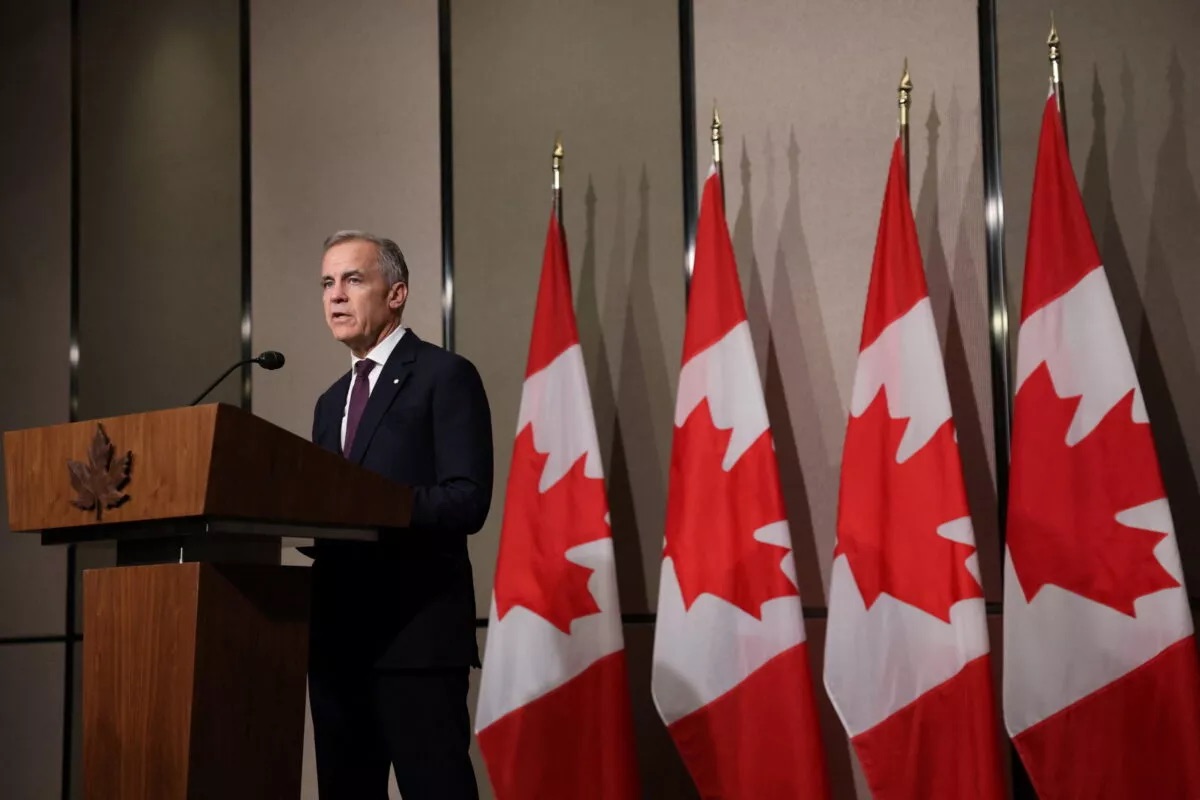
Canadian Prime Minister Mark Carney has repeatedly called for the Canada–ASEAN Free Trade Agreement to be concluded in 2026, raising it with Indonesian President Prabowo Subianto in June. Ottawa sells the agreement as a pillar of its drive to loosen Canada’s dependence on the United States. But the ASEAN label suggests broader market access than the agreement would deliver — only a small number of member states would offer genuinely new openings for Canadian exporters.
Canada’s 2022 Indo-Pacific Strategy named diversification a priority and warned that the country’s trade network needed to become more resilient. That warning became concrete in 2025, when Washington imposed tariffs on Canadian goods. The US Supreme Court struck those tariffs down in February 2026, but US President Donald Trump’s administration reimposed fresh duties within hours under a different statute. The market that takes nearly three quarters of Canadian exports has become a source of chronic unpredictability.
Carney has promised to double exports to non-US markets to US$427 billion per year by 2035, a decade-long structural shift. Even as Ottawa sits down in 2026 to review the Canada–United States–Mexico Agreement with Washington, the diversification track runs on that longer horizon. As a bloc, ASEAN is Canada’s fifth-largest merchandise trading partner, yet it accounts for just around three per cent of Canada’s total merchandise trade.
An ASEAN deal would add less than its name implies. The 2018 joint feasibility study for the deal found that the gains would flow overwhelmingly to ASEAN members outside the Comprehensive and Progressive Agreement for Trans-Pacific Partnership (CPTPP). It projected around US$7 billion in added trade for those economies, against just US$546.3 million for the four already in the CPTPP. Brunei, Malaysia, Singapore and Vietnam trade with Canada tariff-free through the CPTPP already, so an ASEAN deal adds little new market access. Its real payoff lies with the members Canada has yet to reach.
In September 2025, Canada signed a bilateral agreement with Indonesia, by far the largest of the uncovered markets. What remains, where an ASEAN deal would still add value, is a short list — Thailand, the Philippines and the smaller economies of Cambodia, Laos and Myanmar.
Thailand is Canada’s second-largest trading partner in ASEAN, with bilateral merchandise trade of C$7.4 billion (US$5.3 billion) in 2025. The Philippines accounts for a further C$3.4 billion (US$2.4 billion). These are the markets Canadian exporters have pushed hardest to open, from agri-food and clean technology to services.
Canada’s combined trade with Cambodia, Laos and Myanmar is only about a third of its trade with Thailand alone, while Myanmar remains under sanctions. For Canada, the economic case for an ASEAN deal rests almost entirely on Thailand and the Philippines.
Yet Canada is not relying on the ASEAN deal to reach them. In late 2025, it opened separate bilateral negotiations with both Thailand and the Philippines. Ottawa presents these talks as complementary to the regional process and describes the negotiations with the Philippines as a bid for an ‘ambitious, high-standard’ agreement.
A plurilateral deal within ASEAN is built to a common denominator, bound by the bloc’s consensus-based decision making whilst spanning economies as unequal as Singapore and Laos. It cannot ask the least resilient members for what Canada asks of the most resilient ones on procurement, labour, the environment or gender. Bilateral deals are where Ottawa can press for the deeper commitments an ASEAN-wide agreement will not carry.
At the World Economic Forum in Davos in January 2026, Carney cast Canada’s trade strategy as ‘variable geometry’ and championed plurilateral moves like a CPTPP–EU bridge. The ASEAN deal belongs there, and its value extends beyond market access.
Under the CPTPP, Canadian exporters can already pool inputs with Brunei, Malaysia, Singapore and Vietnam. An ASEAN-wide agreement would let firms cumulate across the whole region, drawing in Indonesian, Thai and Philippine inputs and reaching even the economies Canada would not sign a bilateral agreement with on their own. A network of bilateral deals could in principle do the same, through what is called extended cumulation — a clause letting a third country’s inputs count as local. The European Union’s agreement with Vietnam, for instance, lets South Korean fabric count as Vietnamese because the European Union also has a deal with South Korea. But that has to be built in pair by pair — the regional form delivers it in a single text.
An ASEAN deal does not carry Canada’s diversification as far as its label implies. In new market access, that work is already being done bilaterally and on a horizon measured in years.
But market access is the wrong yardstick. Canada is choosing to contract with ASEAN as a bloc rather than market-by-market, treating it as a single counterparty, with the region-wide cumulation that only follows from dealing bloc-to-bloc. In a world sliding towards transactional bilateralism, the agreement would strengthen Canada’s standing as a partner that engages the region on the region’s own terms.
Source: Eastasiaforum
Share:


<p>Time: November 2025<br /> By: WTO and International Trade Group, Legal Department – VCCI</p>
