

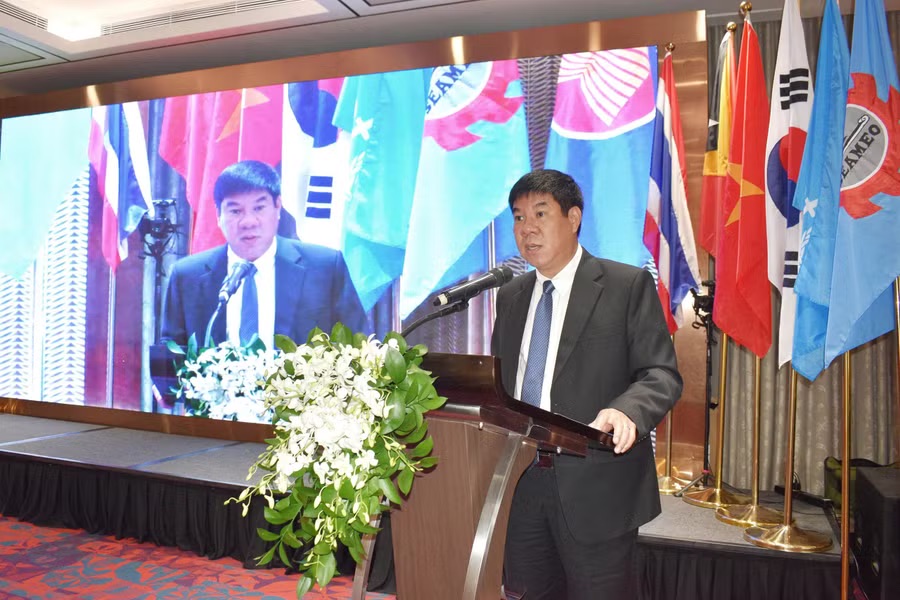
Education experts discuss policies for large-scale international assessments in Southeast Asia aimed at improving basic education.
On the morning of May 14th, the Vietnamese Ministry of Education and Training, in collaboration with the Secretariat of the Southeast Asian Ministers of Education Organization (SEAMEO), organized an international scientific workshop on the theme “Improving Basic Education in ASEAN: Policy Discussion for a Large-Scale International Assessment in Southeast Asia”.
The workshop serves as a forum for countries, international organizations, and education experts to exchange experiences and promote regional cooperation in developing evidence-based education assessment systems, aiming to improve the quality, equity, and sustainability of basic education in ASEAN.
Strengthening regional cooperation in education assessment
In his opening remarks, Professor Huynh Van Chuong, Director of the Quality Management Department (Ministry of Education and Training), stated: The ASEAN Education Action Plan is an important document that guides educational cooperation among Southeast Asian countries, while also creating a foundation to promote cooperation between the region and international partners and development support organizations.
In the context of countries striving to achieve Sustainable Development Goal 4 (SDG4) on quality education, strengthening regional cooperation, particularly in the field of education assessment, is of paramount importance.
To create a forum for sharing experiences and discussing the direction of developing large-scale international assessments in Southeast Asia, thereby providing objective and reliable data to serve the formulation and implementation of national education policies and promote international integration, the workshop aims at three main objectives:
Firstly, share how international large-scale assessment programs are developed and implemented, highlighting lessons learned to strengthen national assessment systems.
Secondly, present how to translate assessment results into practical recommendations to support curriculum reform and assist teachers.
Third, promote peer learning through the sharing of technical expertise, innovation, and national experience in using assessment results and evidence-based decision-making.
According to Professor Huynh Van Chuong, the results of the workshop will contribute to strengthening the cohesion among Southeast Asian countries in the field of education; and at the same time make a practical contribution to the process of reviewing and evaluating the implementation of the ASEAN Education Action Plan.
More importantly, the exchanges and recommendations at the workshop will support the enhancement of the education system's capacity, improve student learning outcomes, and move towards quality, equitable, and sustainable education throughout the region.
Professor Huynh Van Chuong suggested that the Department of Quality Management synthesize the documents and initiatives from the workshop to propose the development of large-scale assessment, contributing to improving the quality and equity of education in Vietnam and the region in the coming years.
Evidence-based education policy planning
Speaking at the workshop, Deputy Director of the Quality Management Department Pham Quoc Khanh said that Vietnam is clearly committed to implementing SDG4 and aims to be among the countries with high-quality education by 2030.
According to the Deputy Director, Vietnam is one of the first countries to develop a national master plan for large-scale assessments to provide data for policy development and monitoring of educational innovation. Currently, Vietnam is simultaneously implementing international assessment programs such as PISA, SEA-PLM, and TALIS along with domestic large-scale assessment programs.
Based on the results of the assessments, Vietnam has identified several factors influencing students' academic performance, such as socio -economic conditions, parents' educational level, language used at home, and the learning environment.
Mr. Pham Quoc Khanh emphasized that Vietnam's current priorities are reducing the percentage of students below standard, narrowing the learning gap between regions, and increasing the number of high-achieving students. Data from international assessments also helps Vietnam clearly identify the gap between students in urban, rural, and mountainous areas, enabling more appropriate resource allocation.
Speaking at the workshop, Ms. Rodora T. Babaran, Director of Human Development at the ASEAN Secretariat, highly appreciated the role of the Vietnamese Ministry of Education and Training in promoting regional education cooperation. In the context of ASEAN implementing the ASEAN Action Plan on Education for the period 2021-2025 and looking towards the period 2026-2030, improving learning outcomes and ensuring quality education continues to be a key priority for countries in the region.
Representatives from the ASEAN Secretariat emphasized that robust and comprehensive evaluation mechanisms play a crucial role in supporting evidence-based policymaking, strengthening the resilience of education systems, and promoting equitable learning opportunities for all learners.
According to Ms. Rodora T. Babaran, large-scale international assessment programs like SEA-PLM not only help countries better understand student learning outcomes but also support the identification of gaps, thereby building more appropriate policies. At the same time, ASEAN is paying special attention to promoting digital transformation in education, but still faces many challenges regarding technological infrastructure, connectivity, and digital pedagogical capacity, especially in remote areas and among disadvantaged groups.
At the workshop, Ms. Datuk Habibah Abdul Rahim - Director of the SEAMEO Secretariat - stated that the SEA-PLM 2024 regional report shows that the learning crisis is still ongoing in Southeast Asia, with only one in two fifth-grade students achieving the minimum reading comprehension level.
Many students finish primary school without the foundational skills necessary for lifelong learning and future entry into the labor market. Gaps in socioeconomic status, gender, language, and learning environments continue to impact children's educational opportunities in the region.
The Director of the SEAMEO Secretariat noted that SEA-PLM is increasingly playing a crucial role as a regional platform helping Southeast Asian countries transform “from data to understanding” and “from understanding to impact.” She emphasized that large-scale assessment programs not only measure learning outcomes but also contribute to shaping educational reform priorities, enhancing accountability, and supporting the development of more adaptable, inclusive, and learner-centered education systems in the future.
Matt Brossard, UNICEF's Senior Advisor on Education, noted that the workshop took place at a crucial time, with only a few years left until the deadline for implementing SDG4. He emphasized the need for accelerated action in the region, with data assessment being a key lever for improving learning outcomes.
UNICEF representatives emphasized the “RUNS” message, which includes: raising standards and minimums; unlocking student potential; bridging gaps; and strengthening the education system. Assessment is not the ultimate goal but a means to improve learning outcomes for all children, especially disadvantaged groups; and encouraged ASEAN countries to promote the use of data throughout the education management system to enhance the effectiveness of policy planning and education governance.
Transforming evaluation results into policy recommendations.
Over the course of a one-day workshop, many valuable experiences, lessons, and initiatives were shared in the field of educational assessment and educational policy planning.
Reports from the Philippines and Thailand focused on their experiences in developing and implementing large-scale international assessment programs to strengthen national assessment systems.
Meanwhile, representatives from Cambodia and Laos shared their experiences in translating assessment results into recommendations for curriculum reform and teacher support.
Malaysia and Indonesia introduced models for promoting peer learning through expertise sharing, innovation, and experience in using assessment results in evidence-based decision-making.
In his closing remarks, Associate Professor Pham Quoc Khanh expressed his belief that the results and recommendations from the workshop would continue to be studied, shared, and effectively applied in the process of developing education policies in each country. He affirmed that large-scale assessment of student learning outcomes, such as the SEA-PLM program, is of significant importance to public education policy because it provides scientific evidence for policy planning, implementation, and adjustment.
Through evaluation data, Ministries of Education can determine the quality of education and the level of student achievement; assess the effectiveness of educational programs and reforms; identify disparities between regions and groups to ensure educational equity; and strengthen data-driven and accountable educational governance.
Source: Vietnam.vn
Share:


<p>Time: November 2025<br /> By: WTO and International Trade Group, Legal Department – VCCI</p>
