

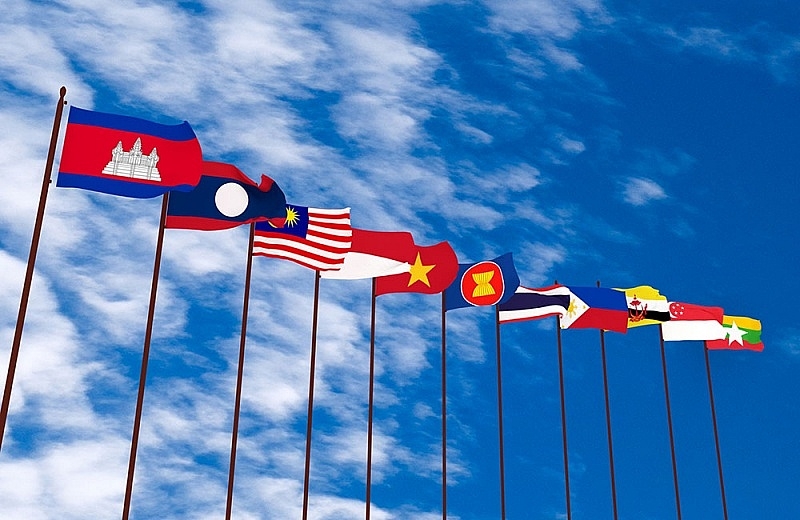
A leap forward in trade
In 2025, Vietnamese businesses are expected to export $38.4 billion to ASEAN; conversely, imports are projected to reach $52.59 billion, an increase of 12%. This will bring the total bilateral trade turnover to $91 billion – the highest level ever.
This figure marks a significant leap forward in over 30 years since Vietnam joined the Association of Southeast Asian Nations (ASEAN) in July 1995.
According to the Ministry of Industry and Trade , economic and trade relations between Vietnam and ASEAN have developed strongly in both scale and depth. In 1995, bilateral trade was just over 3 billion USD, with exports accounting for less than 1 billion USD. After more than three decades, this figure has increased nearly 30 times.
Thailand is currently Vietnam's largest trading partner in the region, with trade turnover reaching US$21.9 billion in 2025; followed by Indonesia (over US$17 billion), Malaysia (over US$16 billion), and the Philippines (nearly US$9 billion). Other markets such as Singapore and Cambodia are also important destinations for Vietnamese goods, with export turnover reaching nearly US$5.8 billion and US$5.6 billion respectively.
In terms of trade structure, ASEAN is a major source of machinery, equipment, and raw materials, with a continuously increasing trend. In 2025, Vietnam's trade deficit with this region exceeded US$14 billion. Key imported items include computers, components, electronic products, machinery, equipment, and spare parts; petroleum products alone accounted for over US$5 billion.
Increase intra-regional trade links.
ASEAN is one of the fastest-growing consumer demand regions in the world , thanks to its large population, growing middle class, and high rate of urbanization.
By 2030, ASEAN is projected to become the world's fourth-largest economy , with a consumer market of approximately US$4 trillion, driven by deep integration, the world's third-largest workforce, and the expansion of the middle class.
Within the ASEAN region, the Philippines is emerging as one of Vietnam's stable and promising export markets, not only due to its large consumer demand but also its ability to maintain a high trade surplus, especially in strategic commodities such as rice.
This is also a key market for many of Vietnam's export sectors, especially rice. In 2024, rice exports exceeded 9 million tons for the first time, reaching nearly $5.8 billion; ASEAN alone contributed $3.9 billion. The Philippines was the largest consumer market, with 3.6 million tons, accounting for 40%.
In 2025, rice exports are projected to decrease to $4.1 billion, but the Philippines will remain the largest customer, accounting for approximately 38-40% in both volume and value, equivalent to 3.2 million tons and $1.57 billion respectively.
According to Mr. Nguyen Chanh Trung, CEO of Hung Viet Rice Co., Ltd. (An Giang), ASEAN has been the largest market for Vietnamese rice for many years and this position remains strong. The advantages lie in the close geographical proximity, similar consumer preferences, and long-standing trade relations.
"Convenient transportation, with most countries having seaports, along with a long history of trade, makes it easier for businesses to maintain their market share through connections and customer care," Mr. Trung said.
The outlook for Vietnam-ASEAN trade is considered positive as countries in the region continue to promote linkages and implement intra-regional cooperation initiatives. At the same time, businesses are increasingly effectively utilizing tariff preferences from FTAs.
According to the Ministry of Industry and Trade, after nearly 30 years of joining ASEAN and almost 20 years of implementing the ATIGA Agreement (since 2010), member countries have basically completed tariff reductions for most goods. In 2024, export turnover using Certificate of Origin (C/O) Form D reached US$14.8 billion, accounting for 40.1% of total export turnover to ASEAN (US$36.9 billion), and is estimated to remain above 40% in 2025.
Source: Vietnam.vn
Share:


<p>Time: November 2025<br /> By: WTO and International Trade Group, Legal Department – VCCI</p>
