

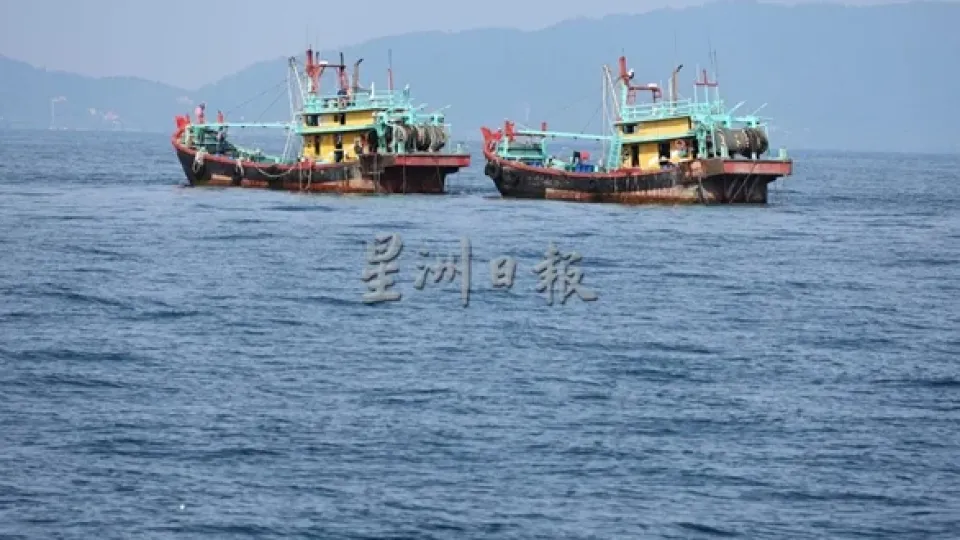
Following Hari Raya, market demand has also softened, with seafood sales in retail markets declining. Traders have been forced to offer discounts, pushing wholesale prices lower.
About 20% of 350 deep-sea fishing vessels classified as C2 have ceased operations due to high diesel costs, says Teoh Boon Guan, secretary of the Kuantan Fishermen’s Association.
Without assistance, this could rise to 30% to as much as half of the fleet by May, he said prices of fish may increase between 20 % and 40% soon, he said.
Common “affordable seafood” such as mackerel, bigeye and yellowtail may no longer be within reach for ordinary consumers.
About 160 deep-sea fishing vessels along the east coast — 90 in Endau, 40 in Kuantan and 30 in Tok Bali have stopped operations.
Teoh said each C2 vessel consumes about 30,000 litres of diesel per month.
At commercial diesel prices of RM5.50 to RM6.50 per litre, monthly fuel costs can reach around RM195,000, accounting for 40% to 60% of total operating expenses — a major factor crippling the industry.
Following Hari Raya, market demand has also softened, with seafood sales in retail markets declining. Traders have been forced to offer discounts, pushing wholesale prices lower.
Teoh, who owns one Class C vessel and four C2 deep-sea vessels, said he is struggling as subsidised diesel cannot be transferred for use by C2 vessels.
To save fuel, he has instructed crew members and skippers to shorten fishing distances and reduce days at sea. Engines are shut off at night if no fishing activity takes place.
“Previously, C2 vessels would travel 20 to 30 hours nonstop to reach prime fishing grounds before trawling. Now, they begin operations after just six hours at sea — long-distance trips are no longer viable,” he said.
“We’re not facing a diesel shortage — we simply can’t afford it,” he said.
Kelantan-based C2 vessel owner Zahril Yaakob said a five-day trip consumes about 5,000 litres of diesel, while a two-week trip uses up to 15,000 litres — costing as much as RM105,000 when fuel prices are high.
“Each trip also requires about 200 blocks of ice costing RM4,000, not to mention food expenses for 25 crew members,” he added.
He urged the government to extend subsidised diesel to C2 vessels, proposing a rate of RM2.50 per litre as a reasonable level to balance fuel prices, operating costs, fish prices and supply chain stability.
He warned that without timely intervention, more than 50% of the country’s over 350 C2 vessels may cease operations, potentially driving fish prices up by 20% to 40%.
“The shutdown of C2 vessels will also severely impact local seafood supply and downstream industries such as frozen seafood, transportation, feed processing and organic fertiliser production,” he said.
Persatuan Peniaga-Peniaga Ikan Endau, a fish dealer association in Endau, urged the government to view the matter seriously, stressing that C2 vessels are not just about fishing but are crucial to the entire seafood supply chain, national food security and the economy.
If deep-sea fishing is hit, the supply of commonly consumed fish such as mackerel, bigeye and yellowtail will be significantly affected, and affordable seafood may no longer be available to the public, said its secretary Cheah.
The secretary, who operates 31 C2 fishing teams, explained that each vessel requires two smaller scouting boats to locate fish schools, resulting in extremely high fuel consumption per trip.
“If the government fails to act, operators will lose confidence and stop investing, and Malaysia’s deep-sea fishing industry could gradually decline,” he warned.
A fisherman in Nibong Tebal, Penang, said he is concerned that if the war continues and energy supplies tighten, the government may further reduce diesel subsidies.
With the current allocation, he can only go out to sea for about 20 days a month. Fishing farther offshore would double fuel consumption.
He hopes authorities will review the system and avoid cutting allocations even in times of shortage, while ideally increasing it to at least 3,000 litres per month to allow fishermen to operate daily.
He added that inshore fishermen rely on manual nets, typically hauling about 15 times a day before returning.
However, during bad weather or slack tides, even 25 hauls may not meet targets — and with fuel costs rising, many are forced to stay in nearshore waters.
Source: Asianews
Share:



<p>Time: November 2025<br /> By: WTO and International Trade Group, Legal Department – VCCI</p>
