

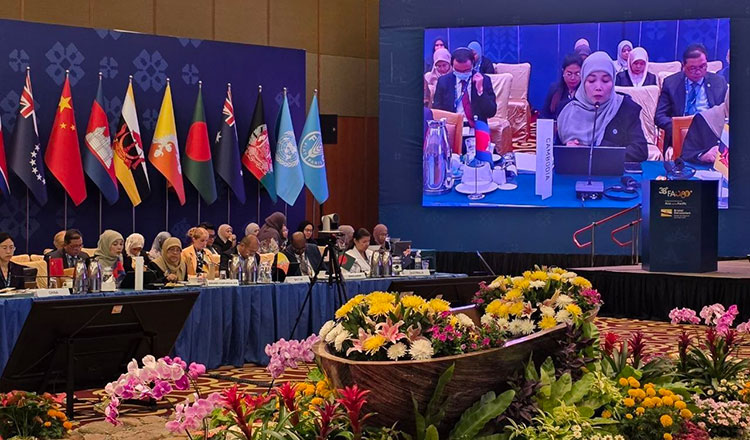
Cambodia has reinforced its pledge to achieve “better production, nutrition, environment, and life” at a high-level regional summit, positioning the kingdom at the forefront of inclusive agrifood transformation.
Yoeu Asikin, Undersecretary of State at the Ministry of Agriculture, Forestry and Fisheries, delivered the address at the opening of the 38th Food and Agriculture Organisation (FAO) Regional Conference for Asia and the Pacific (APRC38) in Brunei Darussalam.
Speaking at Monday’s Senior Officers Meeting, Asikin outlined Cambodia’s transition towards data-driven policy. A significant milestone in this strategy is the integration of the Food Insecurity Experience Scale (FIES) into the 2026 Nationwide Socio-Economic Survey. This move marks the first time Cambodia will measure food insecurity using a global standard, enabling the government to identify and support the most vulnerable populations, particularly women-led households, who statistically face the steepest hurdles in accessing safe and nutritious food.
The Undersecretary also addressed the Lower Mekong region’s specific geographical vulnerabilities. She warned that climate-driven water insecurity and shifting hydrological patterns are now primary drivers of food crises. To combat this, she called for intensified regional cooperation on transboundary water management and the deployment of climate-smart irrigation systems.
“Our 2020 rural data showed that many agricultural households still struggle to secure sufficient nutrition,” Asikin told delegates.
“By integrating the FIES index, Cambodia will be able to pinpoint national food insecurity levels with unprecedented accuracy by the end of 2026, ensuring no one is left behind in our development.”
The conference, running from April 20 to 24, addresses a regional crisis of staggering proportions. According to the FAO, Asia and the Pacific are home to 42 per cent of the world’s undernourished population—roughly 285 million people. While some areas report declining hunger, nearly one billion people in the region face food insecurity, and 1.2 billion cannot afford a healthy diet.
The region is currently battling a “triple burden” of malnutrition: undernutrition, micronutrient deficiency, and surging obesity rates.
Alue Dohong, FAO Assistant Director-General, opened the session by emphasising the urgency of the moment. He noted that geopolitical disruptions and climate shocks have created a “critical juncture” for the region. Dohong urged member states to reshape agrifood systems to be efficient and resilient, specifically calling for increased investment in smallholder and family farmers, who form the backbone of the regional economy.
As the Ministerial Session approaches later this week, Cambodia’s focus remains clear: to leverage international data standards and regional diplomacy to insulate its food supply from mounting pressures from a changing climate.
Source: KhmerTimes
Share:


<p>Time: November 2025<br /> By: WTO and International Trade Group, Legal Department – VCCI</p>
