

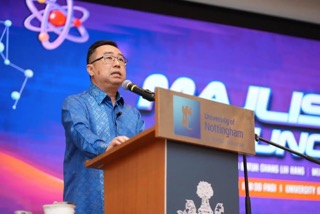
Cynicism, fear and ignorance are the three key problems holding back Malaysia’s science and technology development, said Minister of Science, Technology and Innovation Datuk Chang Lih Kang.
The need to address these key issues to enhance the nation’s technological self-reliance is made more urgent in light of recent geopolitical tensions and supply chain disruptions.
“We need to build technological sovereignty so that we are not constrained by any party in such conditions,” he said at the launch of National Science Week (MSN) 2026 at the University of Nottingham Malaysia.
Chang said that ignorance, in this context, refers to how some Malaysians remain unaware of technological advances taking place beyond the country’s borders, or even students within their own university campuses.
He said this during the TechTalk section of the launch programme, an initiative by the ministry aimed at raising public awareness of technology.
He recalled a meeting in 2024 with China National Space Administration (CNSA), where he proudly shared that Malaysia was preparing to launch its first locally manufactured remote-sensing satellite by 2028.
“I asked them when they launched their first locally-made satellite. They [the CNSA] said how China was a bit backwards because they were heavily sanctioned by other countries in the past and were late to the race. They launched their first remote sensing satellite in 1978. The first ever one was in 1975,” said Chang.
He noted his embarrassment when sharing how Malaysia was only ready to launch its first satellite when countries have been launching theirs for almost 50 years.
“Ignorance is horrible. You need to know what is happening around the world. We must engage with the outside world and the university so we don’t boast about something that is not so great.”
As for cynicism, Chang said that one of the reasons he started the TechTalk initiative was to engage with Malaysians to understand why every Mosti initiatives and announcements are met with hostility on social media.
“Then I found out. It is because of cynicism. People do not trust in our own capability,” he said.
He remembered how, when the Malaysian government expressed its desire to explore nuclear energy to support the country’s green energy transition, many Malaysians reacted with scepticism and unkind words over the idea of exploring nuclear energy as an alternative option.
“Many said it was because we have a bad track record with maintenance, which I admit we do, but in terms of technological capabilities, we are capable,” said Chang.
Chang added that many countries around the world are already exploring or commissioning nuclear energy, including other developing nations like Bangladesh, so he wondered why not Malaysia as well.
He believes that while many Malaysians do not trust in the country’s capabilities, the country has proven to be very capable. Nuclear technology is not new; Malaysia has developed the technology before. On top of that, local engineers are recognised by foreign companies as being fully capable of advanced technological development.
“There is a Turkish aerospace company that has set up an office in Cyberjaya. Türkiye is great in technology; they manufacture their own helicopters and jets. So why come to Malaysia? Because our engineers are good. This company designs avionics, the brains of jets and they employ 150 Malaysian engineers to design their avionics, yet Malaysians still believe we do not have the talent for nuclear,” said Chang.
On fear, Chang touched on fears of new technologies like artificial intelligence (AI) replacing human workers. This is a fear not unique to Malaysia, and Chang believes that it is better for Malaysians to proactively learn about AI and how to effectively utilise it.
Spreading science and technology to students nationwide
This TechTalk was part of this year’s MSN, a flagship programme by Mosti to help promote science, technology and innovation (STI) nationwide, aligned with the National Science, Technology and Innovation Policy 2021-2030.
Chang, in his opening speech, addressed current real-world challenges like the rise of AI, the fears of AI replacing humans and the growth of the global semiconductor industry — of which Malaysia remains a strong key player in its supply chain — currently worth US$600 billion (RM2.3 trillion) and expected to reach US$1 trillion by 2030.
“Malaysia has long been the main player in this supply chain, accounting for about 13% of the global market for the installation, testing and packaging of chips…Through strategic efforts – including the development of ecosystem-based IC design chips and cooperation with global industry players — Malaysia is committed to move towards high-value activities in the technology chain,” said Chang.
In light of these developments, Chang noted that MSN this year is focused on reaching students in both urban and rural communities, especially via programmes such as the Science Carnival, Kembara Sains Borneo, Rehlah Sains and STEM Camp for rural communities.
MSN this year is targeting to reach 1.15 million people across Malaysia, both physically and online. Chang noted that as of Tuesday, MSN has already achieved one million participants.
Source: TheEdge
Share:


<p>Time: November 2025<br /> By: WTO and International Trade Group, Legal Department – VCCI</p>
