

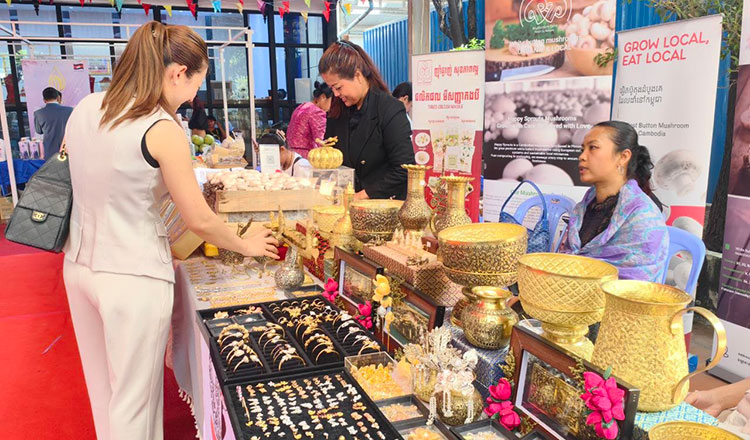
Cambodian products gain 30% of domestic market share, driven by rising public support and a rejection of Thai imports.
Cambodian products are increasingly popular at home, capturing around a 30% share of the domestic market as support for locally made goods rises following a boycott of Thai imports, industry leaders said.
Okhna Te Taing Por, President of the Federation of Associations for Small and Medium Enterprises of Cambodia, said the surge reflects a major shift in consumer behaviour and growing national support for domestic production.
Speaking at a media forum on “Producing Together, Using Local Products Together,” on Friday at the Samdech Techo Foundation for SME Development in Cambodia, he said Ministry of Commerce data show a sharp increase in the consumption of Cambodian products.
He noted that momentum has accelerated rapidly in recent months, with local enterprises expanding production to meet rising domestic demand.
“There has been a strong and noticeable increase in support for domestic products, not only among the general public but also among younger generations, who are showing greater awareness,” he said.
He added that nearly two decades ago, Cambodian products accounted for only about 2% of the market, compared with 30% today.
“This reflects a strong will to support locally produced goods,” he said.
Taing Por said domestic products fall into three main categories: fully Cambodian-made, locally branded goods manufactured abroad under OEM arrangements, and foreign-branded products produced locally by international companies operating in Cambodia.
He highlighted the government’s strategy to promote domestic production, reduce reliance on imports, and encourage greater foreign investment in local manufacturing.
The forum was organised by Club of Cambodian Journalists in collaboration with FASMEC.
Meanwhile, the 3rd Cambodian Products Fair is scheduled to take place at the Koh Pich Convention and Exhibition Centre from April 9 to 12, featuring around 300 booths showcasing locally produced goods, including food and consumer items.
Taing Por said that some Khmer-branded products are still manufactured overseas, as domestic production capacity has yet to fully meet demand, particularly following recent border disruptions.
He said this reliance is expected to decline as overseas production reduces profit margins due to taxation and logistics costs.
“This is not a long-term situation. Some companies are already moving towards establishing production lines in Cambodia, and more factories are expected to emerge in the future,” he said.
He added that Cambodians are also increasingly turning away from foreign services, such as fuel stations and medical treatment abroad, helping to retain significant financial resources within the country.
He emphasised the need to strengthen domestic supply chains in export-orientated sectors. For example, bicycle factories in Svay Rieng province generate billions of dollars in exports, but Cambodia currently benefits mainly from labour income.
The next step, he said, is to increase local production of components, such as screws and parts, to around 50-60%, for greater added value.
Source: KhmerTimes
Share:


<p>Time: November 2025<br /> By: WTO and International Trade Group, Legal Department – VCCI</p>
