

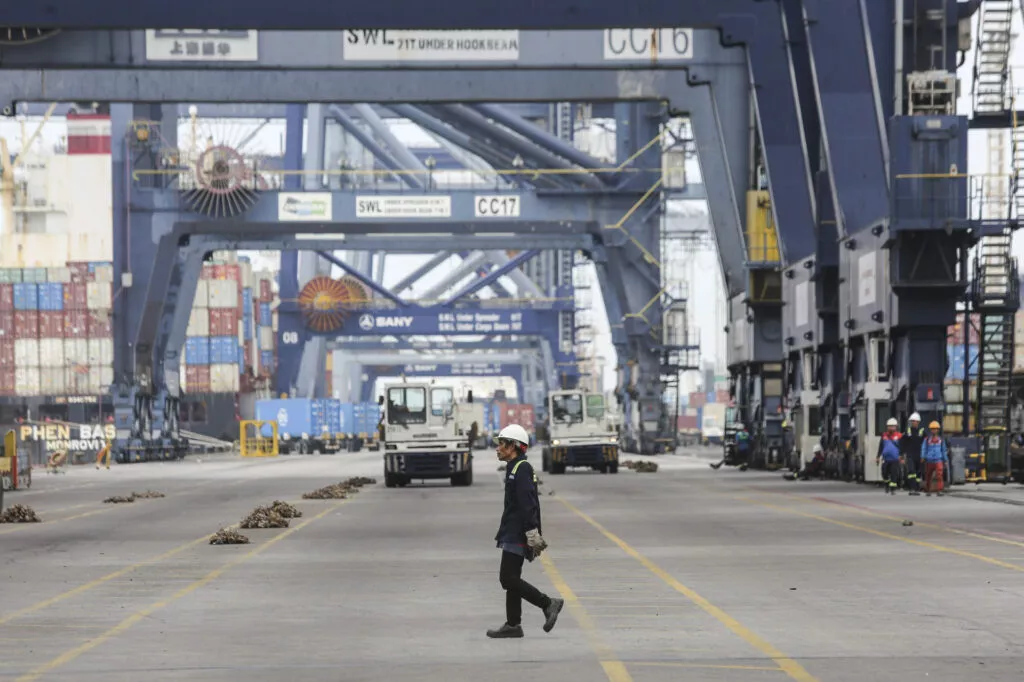
Indonesia and the United States signed a trade deal on 19 February 2026 to reduce the impact of new US tariffs on Indonesian exports, offering temporary relief for sectors such as apparel, footwear and furniture. But the subsequent US Supreme Court ruling against key elements of the Trump administration’s tariff regime exposed the volatility of such bilateral arrangements. The episode has reinforced the importance of more stable regional frameworks such as the Regional Comprehensive Economic Partnership.
The 19 February 2026 Agreement on Reciprocal Trade (ART) between Indonesia and the United States was initially described in Jakarta as a diplomatic success, reducing the additional ‘reciprocal’ tariff imposed by Washington to 19 per cent and exempting 1819 product lines from the extra levy. It also introduced a tariff-rate quota mechanism for textiles that can reduce tariffs to zero within specified volumes.
Yet the US Supreme Court ruled the next day that key elements of the US President Donald Trump administration’s tariff regime were unconstitutional. This prompted the administration to introduce a general tariff rate of 10 per cent. Bilateral tariff arrangements tied to domestic political and judicial processes remain uncertain. The episode reflects a broader trend in global trade policy — as multilateral dispute settlement remains impaired and major economies deploy unilateral tariff tools, many countries are turning to bilateral stabilisation arrangements to manage immediate risks.
Indonesia exported roughly US$34.7 billion in goods to the United States in 2025. Even if exemptions cover only part of the value of exports, avoiding an additional 19 per cent tariff on labour-intensive sectors such as apparel, footwear and furniture likely prevents a serious competitiveness shock. In the short term, the agreement buys breathing space.
But the ART also raises a broader strategic question of whether Indonesia should respond to global trade turbulence through increasingly transactional bilateral arrangements or prioritise strengthening regional frameworks such as the Regional Comprehensive Economic Partnership (RCEP).
Many economies pursue both strategies. Several RCEP members have explored bilateral arrangements with the United States, while China itself continues to seek mechanisms to stabilise trade relations with Washington. For Indonesia, engaging bilaterally with the United States may therefore be a defensive necessity rather than a strategic preference.
The ART differs fundamentally from a conventional free trade agreement. While 1819 product lines revert to treatment under most-favoured nation duties, the United States retains discretion to impose tariffs under domestic trade and national security laws.
Indonesia has committed to eliminating tariffs on 99 per cent of US products and to adjusting selected non-tariff measures — including selected regulatory measures.
These features suggest that ART is less of a comprehensive liberalisation pact than a stabilisation arrangement shaped by bilateral deficit concerns — which risks normalising ad hoc bilateral balancing tied to trade deficits rather than integration based on multilaterally negotiated and predictable rules.
This is where RCEP becomes strategically important. While ASEAN remains the core of Indonesia’s regional economic diplomacy, RCEP extends ASEAN-centred integration across the wider Asia-Pacific production system by linking ASEAN economies with China, Japan, Korea, Australia and New Zealand under a single trade framework. While RCEP has a less intensive focus on regulatory integration than the Comprehensive and Progressive Agreement for Trans-Pacific Partnership, RCEP’s value lies in predictability and scale.
For Indonesia, whose manufacturing competitiveness increasingly depends on regional production networks, RCEP’s cumulation rules are critical. Firms can combine inputs from multiple RCEP members and still qualify for preferential treatment, strengthening regional supply chains.
By contrast, bilateral arrangements that tie improved access to specific purchase commitments or sourcing patterns can distort supply-chain decisions. If exporters adjust procurement decisions to satisfy one partner’s conditions, regional integration incentives weaken. While such arrangements may not breach RCEP obligations, their proliferation could complicate regional production networks and encourage similar bilateral demands from other partners. This narrows policy flexibility and complicates regulatory coherence, exposing Indonesia to renewed pressure whenever bilateral imbalances widen.
The case for prioritising RCEP is reinforced by uncertainty in global trade governance. The World Trade Organization’s Appellate Body remains impaired, limiting multilateral enforcement. The US Supreme Court ruling on the legality of the Trump tariff regime illustrates that if judicial review constrains executive tariff powers — or domestic political dynamics shift — the durability of reciprocal tariff arrangements such as ART could change again.
RCEP is not a perfect substitute for WTO dispute settlement. But it provides an institutional framework for consultation and dispute settlement that can help manage such tensions and offer firms a degree of predictability for long-term investment decisions.
Indonesia and other members should prioritise increasing utilisation of RCEP preferences, particularly among small- and medium-sized enterprises that often lack information or administrative capacity to use regional trade agreements effectively. Governments should ensure that new bilateral arrangements remain broadly consistent with regional supply-chain integration, avoiding procurement or sourcing conditions that could divert production away from RCEP networks. ASEAN members could also strengthen coordination on RCEP implementation by increasing transparency on rules-of-origin utilisation and customs facilitation, so the agreement functions as a genuine regional production platform.
Indonesia’s competitiveness will depend less on tariff relief than on sustained integration into regional value chains. Bilateral arrangements such as the ART may provide short-term stabilisation. But for long-term economic strategy, RCEP — built upon ASEAN’s central role — offers the institutional structure to manage such bilateral engagement. The challenge is not bilateral engagement itself, but ensuring that bilateral deals remain consistent with the broader goal of strengthening regional economic integration.
Source: EastAsiaForum
Share:


<p>Time: November 2025<br /> By: WTO and International Trade Group, Legal Department – VCCI</p>
