

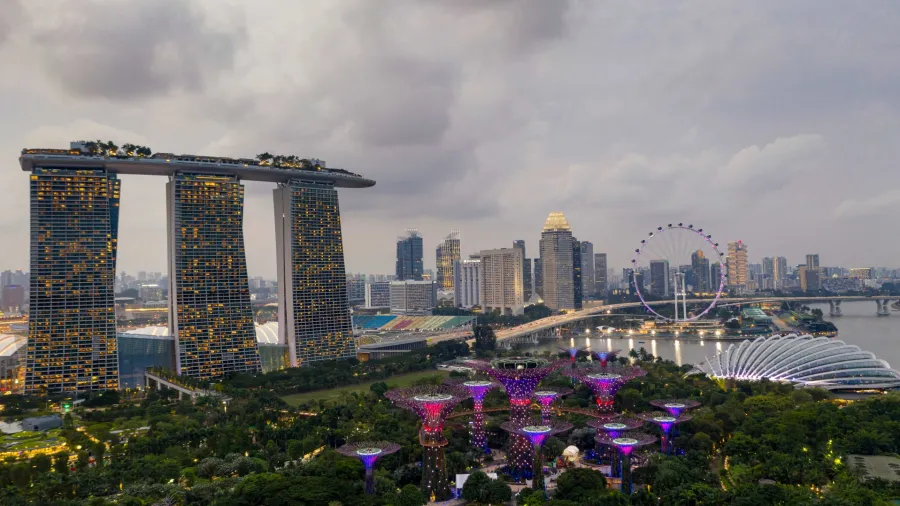
Middle East tensions and oil risks overshadow Singapore’s export resilience.
Singapore’s economic outlook has been trimmed despite non-oil domestic exports (NODX) rising 6.7% year-on-year (YoY) in January and February, as escalating geopolitical tensions threaten to weigh on trade.
Maybank Research Pte Ltd lowered its 2026 GDP growth forecast to 3.4% from 3.6%, citing that risks from the Middle East conflict and disruptions in the Hormuz Strait have disrupted global commodity shipments.
“The petrochemical sector, which accounted for 6.6% of exports in 2025, faces the most pronounced impact, with output curbs due to a crunch in crude oil-derived naphtha,” it said.
In addition, the transport and hospitality sectors may also be negatively impacted.
Join Singapore Business Review community
The downgrade comes even as exports remain supported by strong demand for electronics linked to artificial intelligence (AI).
Electronics shipments grew 43.2% year-on-year in February, although this marked a slowdown from the 56.1% expansion in January.
Meanwhile, the bank said non-electronics shipments declined 6.9%, dragged by non-monetary gold and food preparations.
Petrochemical shipments fell for the 12th consecutive month, declining 28.5% in February, a sharper drop than the 24.5% fall in January.
However, exports in the sector could rebound when raw material flows return, Maybank added.
In a separate report, RHB pointed out that ‘ongoing geopolitical noise’ could weigh on growth, whilst maintaining a 3.0% full-year NODX growth forecast.
“Singapore’s growth and trade will be negatively impacted should the Middle East tensions exacerbate into the first half of 2026,” it said.
Higher oil prices are also expected to weigh on trade, as a large share of Singapore’s crude oil supply comes from the region, particularly the UAE, Qatar, and Saudi Arabia, which together account for about 70% of imports.
“Specifically, we note that Singapore’s share of energy imports in total imports is the highest among key ASEAN economies, at 20.3% over the 2020-2024 period,” RHB added.
UOB said recent tensions could disrupt key inputs such as helium and naphtha used in semiconductor and plastics production.
“These disruptions could have further, more severe knock on effects on downstream production and consequently, on exports and growth,” it added.
'Tariff concerns'
The bank also noted persistent weakness in shipments to the US amidst tariff uncertainties.
Risks to US-bound exports could persist as the Office of the US Trade Representative has launched Section 301 investigations into several economies, including Singapore, over excess capacity and alleged use of forced labour.
“These developments imply a risk of higher and more durable US tariffs, which could weigh on NODX to the US, although base effects will turn supportive from May 2026 onwards,” UOB said.
Moreover, the Trump administration has imposed a broad 10% tariff for up to 150 days under Section 122, with the option to raise it to 15%.
Source: Singapore Business Review
Share:

<p>Time: November 2025<br /> By: WTO and International Trade Group, Legal Department – VCCI</p>
