

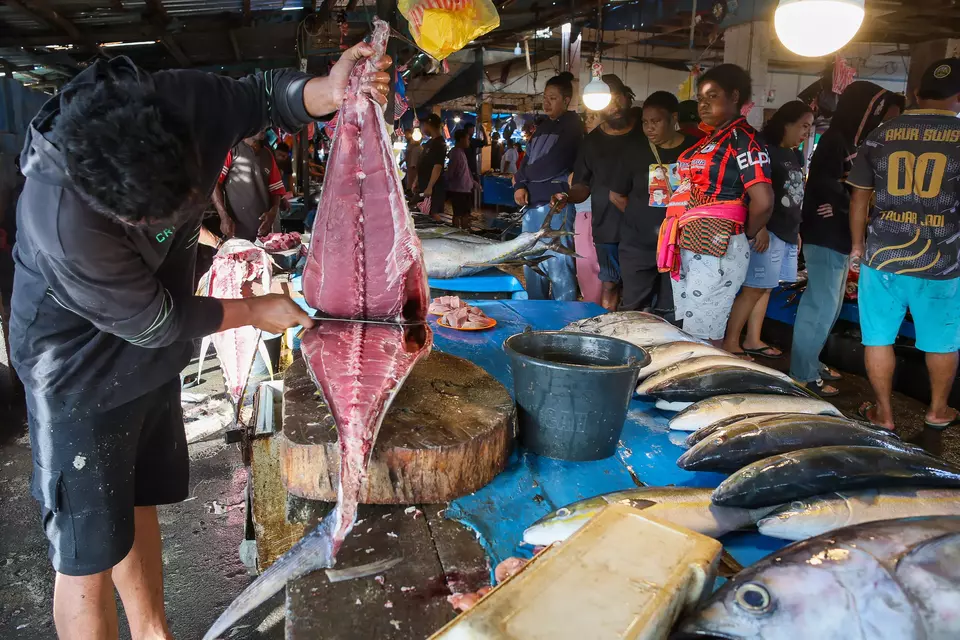
Indonesia’s fisheries exports have taken a sharp hit as escalating geopolitical tensions in the Middle East, particularly the Iran conflict, disrupt global logistics, cutting shipment volumes and raising costs.
The Maritime Affairs and Fisheries Ministry (KKP) reported that export volumes fell by 41.35% year-on-year, while export value declined by 21.71%.
Head of Quality Control and Supervision Agency for Marine and Fisheries Products at KKP, Ishartini, said the downturn was primarily driven by supply chain disruptions rather than weakening demand.
“On the volume side, exports are constrained as supply chains are affected by the escalation, including changes in shipping routes, higher logistics costs, and limited availability of containers and mother vessels, all of which contribute to rising product prices,” Ishartini said.
She added that global supply chain disruptions remain the key factor weighing on export performance, even as international demand stays relatively stable. This is reflected in the continued issuance of Fishery Product Quality and Safety Certificates (SMKHP), indicating ongoing export activity.
From the start of the year to mid-March 2026, just ahead of Eid al Fitr or locally called Lebaran, Indonesia recorded $983.1 million (Rp 16.7 trillion) in fisheries exports, with shipment volumes reaching 197,718 tons as of March 13.
The figures are based on SMKHP certifications, which serve as food safety standards recognized across 140 trading partner countries.
Indonesia’s top export commodities include vannamei shrimp, tuna, squid, blue swimming crab, seaweed, skipjack tuna, crab, black tiger shrimp, hairtail, and octopus. Key export destinations remain the United States, China, Japan, Viet Nam, Thailand, Malaysia, Australia, Saudi Arabia, and Singapore.
To cushion the impact of global pressures, the ministry plans to boost domestic absorption of fisheries products. It is also intensifying coordination with partner countries and local stakeholders to maintain trade stability amid ongoing global uncertainty.
Source: Jakarta Globe
Share:

<p>Time: November 2025<br /> By: WTO and International Trade Group, Legal Department – VCCI</p>
