

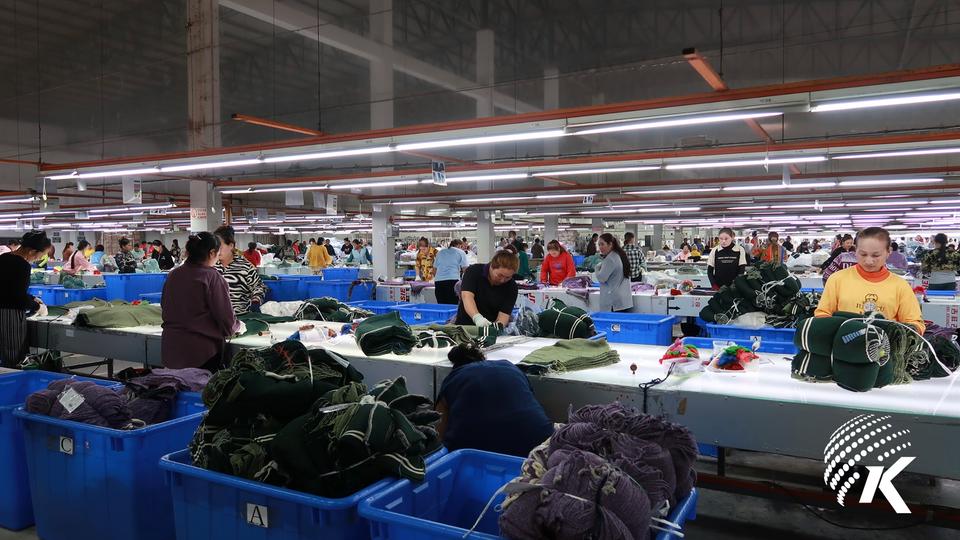
Office of the United States Trade Representative has launched a Section 301 investigation targeting 16 trading partners, including Cambodia, over alleged structural excess manufacturing capacity and trade surpluses, citing the Kingdom’s over $12 billion surplus with the US and strong garment exports
Cambodia is among 16 US trading partners targeted in a Section 301 investigation launched by the United States Trade Representative (USTR) over structural excess manufacturing capacity, with experts warning the probe may raise uncertainty for investors while urging the Kingdom to engage with the USTR, diversify exports, and address structural competitiveness to boost resilience and appeal to international buyers.
According to the Office of the USTR, the Section 301 probe of the Trade Act of 1974 examines the acts, policies, and practices of certain economies related to structural excess capacity and production in certain manufacturing sectors.
It noted that key trading partners have built production capacity beyond domestic and global demand, causing overproduction, persistent trade surpluses, and underused manufacturing capacity.
“These investigations will focus on economies that appear to exhibit structural excess capacity and production in various manufacturing sectors, such as through large or persistent trade surpluses or underutilised or unused capacity,” it said.
Section 301 targets China, the European Union (EU), Singapore, Switzerland, Norway, Indonesia, Malaysia, Cambodia, Thailand, Korea, Vietnam, Taiwan, Bangladesh, Mexico, Japan and India.
Cambodia is among the targeted under Section 301, with an official notice stating that the nation recorded an approximately $1 billion bilateral trade surplus with the US in 2024, while its garment, footwear and travel goods (GFT) sector exported $11.8 billion in the first nine months of 2025, a 16 percent increase from the same period in 2024.
“When Cambodia’s GFT industry was facing uncertainty with US tariffs, Cambodia’s Deputy Secretary-General stated that enhancing capacity along the product chains was an option to further boost the manufacturing sector and create lucrative opportunities,” it pointed out as evident.
Arnaud Darc, Chairman and CEO at Thalias Group, said the investigation does not specifically target Cambodia, as it covers 16 economies. However, Cambodia’s exposure should not be underestimated.
He said that the US is Cambodia’s largest single export destination, absorbing roughly 38 percent of total exports, and the export structure remains highly concentrated in GFT, making up over half of export earnings and supporting roughly 900,000 jobs across more than 1,500 factories.
He said that this investigation highlighted Cambodia’s vulnerability as structural rather than behavioural. The Kingdom is not “a major source of global industrial overcapacity” and does not “operate large state subsidised manufacturing systems” comparable to those under scrutiny in larger economies, and largely based on contract manufacturing integrated into buyer-driven global supply chains.
“The real risk lies in dependence on a single export market and a narrow cluster of labour-intensive products that represent a significant share of national exports and formal manufacturing employment,” he said, stressing that if trade restrictions or tariffs are applied broadly rather than selectively, “Cambodia could face collateral impacts that are disproportionate to its actual role in global manufacturing dynamics”.
Darc said that the immediate risk is not a sudden collapse of exports but “increased uncertainty for investors and international buyers”, as global manufacturing supply chains are highly sensitive to policy stability.
“Investigations of this nature can slow sourcing decisions, delay investment in new factories, and encourage buyers to diversify orders across multiple countries as a hedge against potential trade measures,” he said.
A container ship carries truck-sized intermodal containers from abroad to Sihanoukville, Cambodia. Kiripost/Siv Channa
Kiripost contacted Pen Sovicheat, Spokesperson for the Ministry of Commerce, regarding the issue, but he said he is seeking information from the specialist department.
USTR will open dockets for written comments and hearing requests from March 17, with submissions and testimony summaries due by April 15, and public hearings scheduled to begin May 5.
Engage, diversify and address structural competitiveness
Darc said that Cambodia authorities and industry associations should actively engage during the USTR consultation process, clearly explaining Cambodia’s export model and emphasising that the country’s manufacturing sector operates primarily through buyer-driven supply chains rather than through state-driven industrial overcapacity.
“It will also be important to demonstrate that Cambodian exports reflect genuine value-added production rather than transhipment from other manufacturing systems,” he said.
Darc added that Cambodia should accelerate diversification of its export markets since an export structure in which a single country absorbs close to 40 percent of shipments creates structural vulnerability.
“Expanding exports within regional trade frameworks and growing markets in Asia would reduce this concentration risk over time,” he said.
Darc recommended that the Kingdom should continue addressing structural competitiveness challenges as energy costs, logistics performance, and customs efficiency remain less competitive than in several manufacturing economies in the region.
“Reducing these structural costs and improving the business environment would strengthen resilience against external trade shocks and increase Cambodia’s attractiveness for international buyers,” he said.
Before the Supreme Court of the US struck down Trump’s global tariffs as illegal under the national emergencies law on February 20, Cambodia faced a 19 percent tariff rate from the US after playing its “last card” by removing all duties on US imports and agreeing to purchase 10 Boeing 737 Max 8 aircraft.
According to the General Department of Customs and Excise, in 2025, Cambodia exported $12.73 billion worth of goods to the US, an increase of 28.48 percent, and imports rose 57.83 percent to about $417 million, putting total bilateral trade at $13.14 billion.
Source: Kiri Post
Share:

<p>Time: November 2025<br /> By: WTO and International Trade Group, Legal Department – VCCI</p>
