

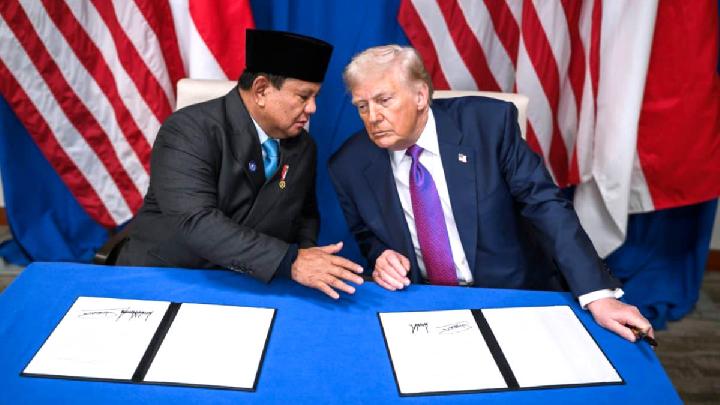
Professor of agricultural policy economics at Bogor Agricultural University (IPB), Sahara, believes that the scope of commitments in Indonesia's Agreement on Reciprocal Trade (ART) tends to provide more structured benefits for the United States (US). Meanwhile, the benefits obtained by Indonesia are considered more limited and are heavily dependent on certain commodities.
"The United States tends to obtain structured benefits. Indonesia obtains positive benefits, but tends to be commodity-based," said Sahara in a national seminar held online via Zoom on Saturday, March 14, 2026.
He revealed that the United States not only has the potential to increase exports of agricultural commodities, energy, and high-value manufactured products to Indonesia, but also obtains various other commitments, such as in the digital trade field, cross-border data flow, data localization policy restrictions, regulatory transparency, protection of intellectual property rights, and alignment of strategic export controls.
Based on the analysis conducted by his team, he said that Indonesia's benefits from the reciprocal trade agreement are more short-term in nature. Meanwhile, the medium to long-term benefits are on the side of the United States.
He also highlighted the possibility of retaliation from other countries due to the trade agreement. Therefore, Sahara believes that the ART still needs to be ratified, but with caution in its implementation. According to him, the Indonesian government needs to ensure that the market access obtained can be transformed into sustainable industrial transformation and still maintain economic sovereignty.
Sahara cited that one of the issues that needs to be considered is the possibility of eliminating non-tariff policies, such as the local content requirement. If this policy is removed, according to him, its impact on the domestic industry, including the possibility of deindustrialization, needs to be considered.
He also highlighted the future of the guarantee service or certification industry in Indonesia. According to him, this sector plays a crucial role in protecting consumers, including ensuring the standards of products circulated in the market. One example he mentioned is the halal certification standard.
Sahara explained that the halal standard in Indonesia may potentially differ from standards in other countries, including in the method of animal slaughter or the pre-slaughter stunning process. Therefore, he believes that certification institutions in Indonesia play a crucial role in ensuring that the circulated products truly comply with the applicable standards in the country.
Additionally, he considers the entry of agricultural products from the United States into the Indonesian market needs to be thoroughly studied. This is related to the sustainability of the food self-sufficiency program, changes in the trade map, and the potential retaliation from other countries.
Source: TEMPO.CO
Share:

<p>Time: November 2025<br /> By: WTO and International Trade Group, Legal Department – VCCI</p>
