

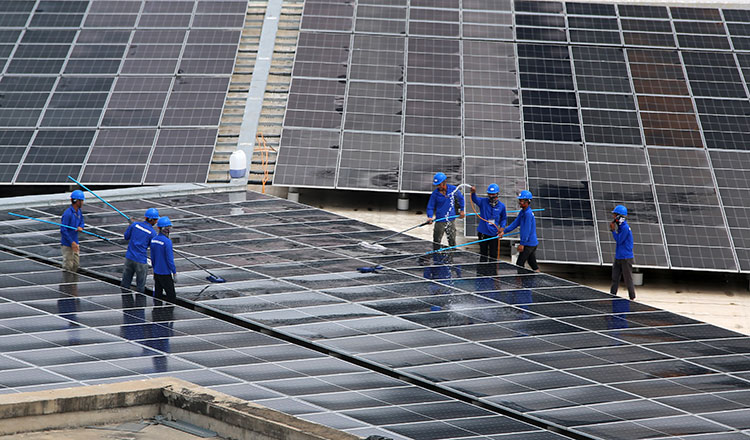
Expanding green energy will strengthen the Kingdom’s economic competitiveness. As global industries and investors increasingly prioritise environmental sustainability, a stronger renewable energy sector could help attract new investment and support tourism.
Minister of Mines and Energy Keo Rottanak has reiterated the Royal Government’s commitment to expanding clean energy and promoting energy efficiency as part of efforts to reduce Cambodia’s heavy reliance on imported fuel and ease the financial burden on workers in the transport sector. The country is well on course to achieve 70 percent clean energy target by 2030, the minister maintained.
Speaking on Sunday afternoon during a provincial party meeting in Pursat, the minister said the government is encouraging the adoption of renewable energy and conservation measures amid rising global oil prices driven by geopolitical tensions.
Rottanak warned that ongoing conflicts in the Middle East are contributing to higher global prices for oil and other commodities, affecting economies around the world. Despite these pressures, he said Cambodia has maintained economic stability and continued to pursue development.
“The government is closely monitoring global developments while promoting the use of clean energy and energy-saving measures to reduce dependence on imported oil,” the minister said.
During the meeting, Rottanak met with over 400 local transport workers, including motorcycle taxi, taxi cab and tuk-tuk drivers. The gathering was also attended by provincial deputy governors and officials from several government departments.
He told the drivers that they play an essential role in Cambodia’s economy, providing daily transport services to both residents and visitors. According to the minister, the Royal Government’s policies aim to support workers in the informal economy by promoting more stable incomes and safer working conditions.
Transport workers are particularly sensitive to fuel price fluctuations, as their earnings are closely tied to operating costs. By reducing reliance on imported fuel through alternative energy sources and improved efficiency, the government hopes to shield drivers and other workers from the volatility of global energy markets.
Rottanak also stressed that maintaining peace and stability is essential for economic growth. While global conflicts continue to disrupt energy supplies and push up prices, he said Cambodia remains committed to maintaining a peaceful environment that allows development to continue.
He added that the country will continue addressing border issues through peaceful negotiations and in accordance with international law, while cooperating with neighbouring countries to avoid conflict that could harm communities on both sides.
Earlier last week, speaking at the Cambodia-ASEAN Business Summit 2026 in Phnom Penh, Rottanak said clean energy accounted for approximately 63 percent of the country’s total energy mix by 2025.
He noted that Cambodia is on track to achieve its target of generating 70 percent of its electricity from clean sources by 2030. Several newly approved renewable energy projects are expected to further increase the share of clean energy to about 67 percent by the end of 2026.
“This growth will help Cambodia move closer to achieving its 2030 vision of increasing clean energy consumption to 70 percent,” the minister said.
Currently, most of Cambodia’s clean energy comes from hydropower, solar power and biomass generation. The country’s renewable energy share already exceeds the regional target set by Association of Southeast Asian Nations, which aims for 35 percent renewable energy in the region’s energy mix by 2030.
Cambodia’s transition toward a greener energy system is guided by the Power Development Master Plan 2022-2040, which has led to the approval of multiple renewable energy projects across the country.
The roadmap reflects the Royal Government’s broader commitment to sustainable development and its long-term objective of achieving carbon neutrality by 2050.
Rottanak also noted that expanding green energy could strengthen Cambodia’s economic competitiveness. As global industries and investors increasingly prioritise environmental sustainability, a stronger renewable energy sector could help attract new investment and support tourism.
In addition, the clean energy transition is expected to create new employment opportunities, particularly for young people entering the workforce, while supporting Cambodia’s long-term economic growth and environmental goals.
Source: Khmer Times
Share:

<p>Time: November 2025<br /> By: WTO and International Trade Group, Legal Department – VCCI</p>
