

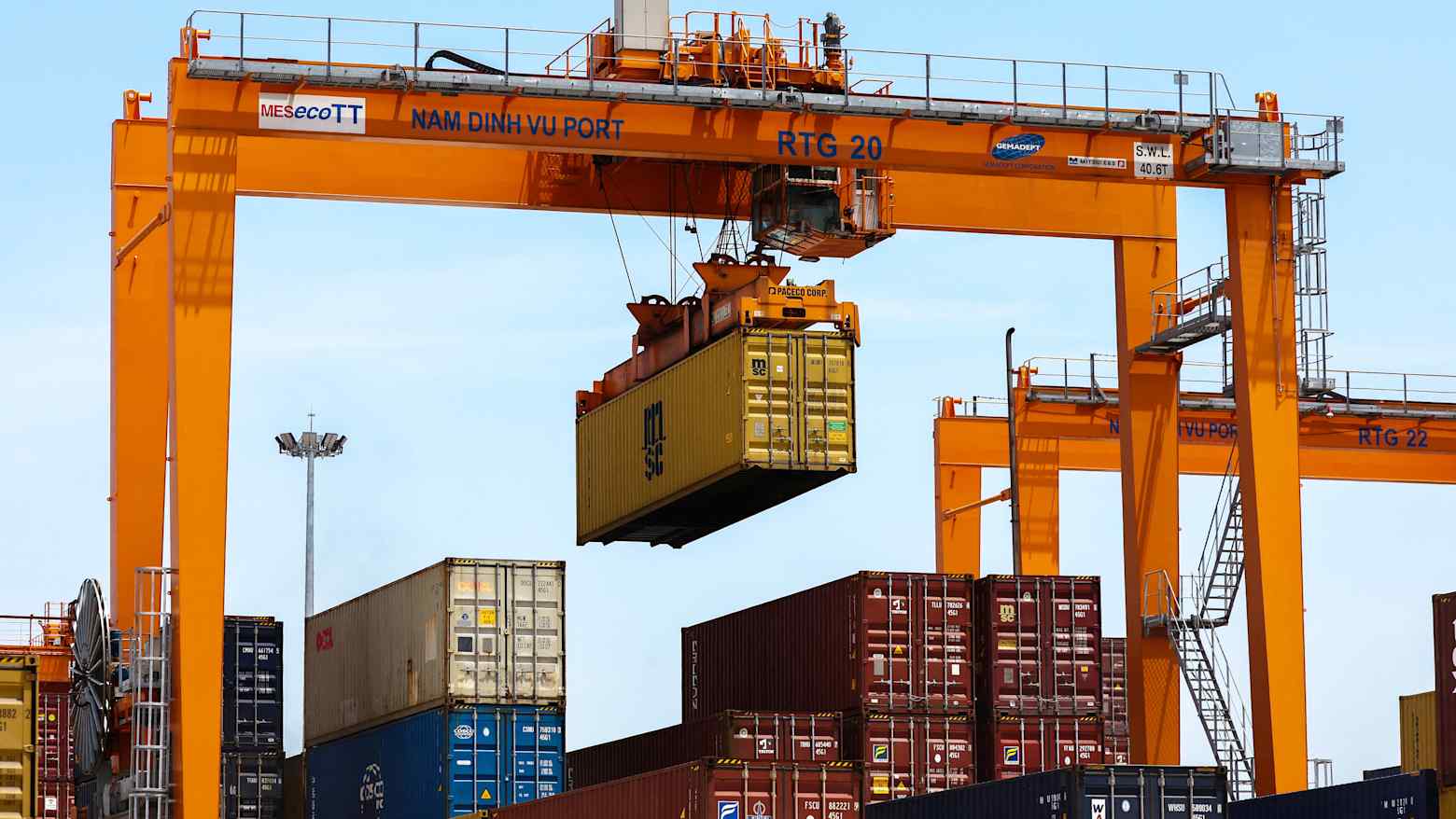
Southeast Asian exporters say they are unsure whether or how to adjust supply chains, pricing strategies and shipment schedules now that the U.S. Supreme Court has struck down President Donald Trump's "reciprocal" tariffs, bringing fresh uncertainty and volatility to global trade.
Businesses across the region say they are navigating what many describe as a "gray zone" in trade policy with "little going according to plan," both in their dealings with American buyers and the impact of the court ruling on rivals, notably China.
"There is now a legal flux that makes it difficult to set a stable business plan," Shinta Kamdani, chairwoman of the Indonesian Employers Association (Apindo), told Nikkei Asia.
Across Southeast Asia, there is uncertainty over how long the current arrangements will last, what will follow and how U.S. customs might interpret evolving rules during the transition period.
In the wake of the Supreme Court ruling, Trump imposed 10% tariffs across the board under legislation that permits him to do so for 150 days and said he intended to increase the rate to 15%. The new rate is lower for all ASEAN states except Singapore and East Timor, which were facing 10% levies.
"The uncertainty surrounding this latest trade war has not yet ended," said Poj Aramwattananont, chairman of the Thai Chamber of Commerce.
Roland Rajah, lead economist at the Sydney-based think tank Lowy Institute, sees a paradox in the region's position. While trade diversion and shifting of supply chains out of China may benefit Southeast Asia, countries that have already signed bilateral agreements with the U.S. -- Cambodia, Malaysia and Indonesia -- are facing major uncertainty.
"Complicating matters for Southeast Asia is that China is one of the biggest immediate beneficiaries of the court's decision," Rajah wrote.
Abdul Sobur, secretary-general of the Indonesian Furniture and Craft Association, summarized many businesses' approach as "stay exporting while de-risking."
Unlike before the "reciprocal" tariffs came into effect last year, front-loading -- rushing goods to the U.S. -- is being undertaken only selectively, he told Nikkei. "Production that is still in the forecast stage or has only a very thin margin and is sensitive to tariffs will be postponed until cost-sharing is finalized with the buyer."
Sergio Ortiz-Luis, president of the Philippine Exporters Confederation, echoed this holding pattern. "We can't even front-load because we're not sure whether the U.S. will take those goods in," he told Nikkei.
Indonesian palm oil exporters, meanwhile, remain cautious. The country secured a tariff exemption for its main commodity in a deal that Jakarta and Washington signed the day before the court ruling. "Growing exports will be more challenging," Eddy Martono, chairman of the Indonesian Palm Oil Association, told Nikkei.
Other businesspeople described their approaches this week as a "re-evaluation" or "tactical recalibration." Ng Yih Pying, president of the Associated Chinese Chambers of Commerce and Industry of Malaysia, told Nikkei that it is "difficult to say that anything is going according to plan."
Malaysian electronics and electrical manufacturers are selectively front-loading shipments, advancing deliveries where feasible without overextending inventories, exporters said. But they declined to comment publicly since the sector is so exposed to U.S. national security measures.
MSSB Research warned that a U.S. administration shift toward more targeted measures could expose semiconductors and advanced electronics to renewed risks.
Mohamed Safwan Othman, chairman of the Malaysian Shipowners' Association, said the immediate impact of the new tariff regime is likely to be felt more in container liner services than in bulk shipping but that while the lower tariffs may result in some trade flow adjustments, he said the impact is unlikely to be significant since there is only certainty for 150 days.
In Viet Nam, some businesspeople predict Southeast Asia's fastest-growing economy might be able to continue last year's trend of picking up more supply chain links due to relocation.
Vinacapital CEO Don Lam said the trend will pick up pace as the Trump administration will need to "pick its battles" and focus its tariff efforts on China.
Viet Nam, however, has yet to finalize a trade deal with the U.S., adding to the uncertainty about what tariff rates will be imposed on different goods.
Apparel, seafood and shipping companies will benefit in the eased tariff environment, Lam told Nikkei Asia, adding that Viet Nam retains some structural advantages. "As long as tariffs on its exports to the U.S. are not more than 10 percentage points higher than competitors, Viet Nam's other advantages, such as low costs and a high-quality labor force, provide a competitive edge."
In Singapore, where trade is deeply embedded in the economy, manufacturers are taking a more structural view of the turbulence.
The Singapore Manufacturing Federation, which represents more than 5,000 companies, said conditions remain unsuitable for long-term investment planning in the U.S.
"While some may hope for refunds following the Supreme Court ruling, these are paid by U.S. importers, making it difficult for Singapore manufacturers to recover costs," said Lennon Tan, president of the industry group.
Rather than waiting for clarity, many companies are accelerating diversification efforts to reduce reliance on a single major export destination.
"There are accelerated efforts to reduce exposure to single market shocks and enhance resilience against abrupt policy shifts," said Shafiqah Abdul Samat, principal adviser for trade and customs at KPMG in Singapore.
Some exporters are front-loading shipments where feasible, aiming to stay ahead of potential cost increases, while others are reassessing contractual obligations and exposure before committing to further expansion.
In Cambodia, Better Factories, an International Labor Organization-backed industry monitoring group, reported that manufacturers have been asked to reduce prices by U.S. brands.
The Asian Development Bank has warned that the new tariff regime will have macroeconomic implications for Cambodia. "The global trade policy environment is volatile, and small adjustments in the relative tariff across competing export-oriented economies would leave Cambodia vulnerable," it said in a statement.
Gene Fang, a Moody's Rating associate managing director, said the uncertainty will remain the dominant theme across the region.
"There is a scenario where the [U.S.] administration will try to find ways to impose tariffs back towards levels that we saw at the end of 2025," he said. "There is also a scenario where 15% prevails."
Source: Nikkei Asia
Share:

<p>Time: November 2025<br /> By: WTO and International Trade Group, Legal Department – VCCI</p>
