

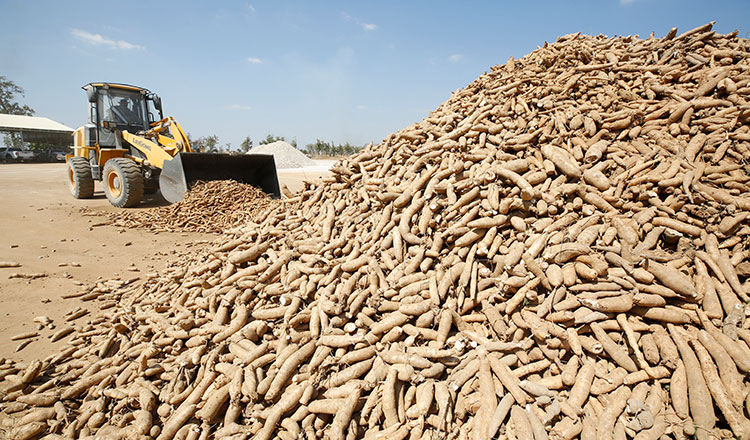
Analysts warn that if the border impasse persists, the ripple effects could extend beyond farms and markets to broader rural economies where cassava cultivation supports tens of thousands of households.
Cassava farmers and traders in Cambodia are facing mounting hardship as lingering tensions and border closures linked to the ongoing conflict with Thailand disrupt one of the Kingdom’s key agricultural export lifelines. Once a brisk business supplying raw cassava to Thai processors, the sector is now grappling with sharply reduced cross-border flows, lower prices, and uncertain trading routes.
Cassava — a starchy root crop central to rural livelihoods in provinces such as Battambang and Pursat — traditionally accounts for a significant share of Cambodia’s agricultural exports. Much of the fresh root harvested in the Kingdom historically flowed to Vietnam and Thailand, where it is processed into starch, chips, animal feed and bioethanol for both domestic use and re-export. Since the escalation of tensions with Thailand, traders have encountered logistical bottlenecks and price collapses.
Following the closure of land crossings, Cambodia’s agricultural exports — including cassava shipped by water to Thailand — dropped to 1,728 tonnes, valued at $5.8 million, between June 24 and September 30, 2025. The monthly value declined by 6.6 percent, falling to $1.7 million compared to a previous estimate, according to the General Directorate of Agriculture.
Official estimates pointed out that more than 50 percent of the crop is exported to Vietnam, 35 to 40 percent to Thailand and only 10 percent is sold in domestic markets.
Local farmers say transport restrictions have throttled demand at the border with Thailand, forcing many to sell at steep discounts or store produce with mounting costs. “Without Thai buyers coming to collect, we can’t move our cassava,” said a farmer in Battambang, adding, “Prices have fallen and many traders can’t afford to wait.”
With diminished access to Thailand, Cambodia’s cassava exports have shown only modest growth last year, stalling at around 1.1 million tonnes in the first quarter of 2025 against expectations of higher volumes.
The slump comes at a difficult time for farmers already squeezed by rising input costs, particularly expensive fertilisers and fuel — inputs for which Cambodia has increasingly relied on imports even prior to the conflict.
Traders are also feeling the pinch. Border markets that once bustled with cassava deals — alongside other Cambodian agricultural products — have seen extended lulls, with some vendors quietly closing shops after months of muted sales. For exporters who had built commercial relationships and contracts with Thai and regional processors, the uncertainty has prompted re-routing efforts toward alternative destinations such as Vietnam, which recently clinched a long-term cassava purchase agreement expected to absorb some of the Kingdom’s harvest.
On October 23, last year Cambodia and Vietnam signed a memorandum of understanding (MoU) to boost the Kingdom’s fresh cassava exports to Vietnam to nine million tonnes a year. The agreement was signed in the presence of Cham Nimul, Minister of Commerce, alongside representatives from the Vietnamese Embassy in Cambodia, the Cambodian Cassava Federation, and the Vietnam Cassava Association.
The MoU outlines closer collaboration in cassava production, processing, and marketing, reflecting a shared commitment to strengthening bilateral trade. Nimul expressed optimism that the agreement would elevate Cambodia’s cassava industry while deepening economic and agricultural ties between the two nations.
In addition to the main MoU, four Cambodian-Vietnamese companies signed commercial contracts pledging to purchase over three million tonnes of fresh cassava from Cambodia each year. This initiative is expected to deliver substantial benefits to local farmers, support rural livelihoods, and contribute to national economic growth.
Yet Viet Nam alone cannot match the scale of lost Thai demand, and logistical reconfiguration — including increased reliance on river and sea transport — remains costly and slow to materialise. Domestic processing capacity in Cambodia, still limited compared with its neighbours, looms as another bottleneck.
Source: Khmer Times
Share:


<p>Time: November 2025<br /> By: WTO and International Trade Group, Legal Department – VCCI</p>
