

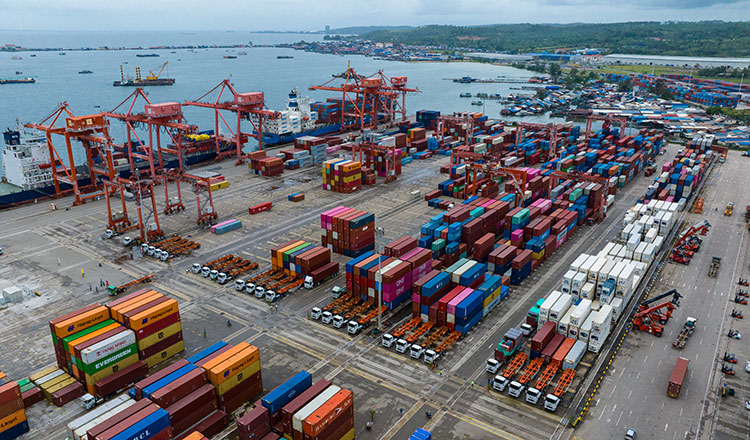
Focusing on visa facilitation, transparent business practices, and understanding Japan’s market will allow Cambodia to strengthen economic relations, attract more investors, and create new opportunities.
As regional trade shifts and Cambodian consumer preferences evolve, Japan is emerging as a key economic partner, with bilateral trade surpassing $2.5 billion in 2025, highlighting steady cooperation and its role as one of the Kingdom’s most reliable long-term partners.
Latest trade data from the General Department of Customs and Excise (GDCE) showed solid growth in bilateral trade, supported by rising exports, increasing imports of high-value goods, and Cambodia’s deeper integration into regional supply chains.
According to GDCE Trade Balance Statistics, Cambodia exported goods worth approximately $1.5 billion to Japan last year, representing a 11.9 percent increase compared to the year-on-year period.
Meanwhile, Cambodia imported goods from Japan valued at around $956 million, up 27 percent from $752 million in 2024. As a result, total bilateral trade volume exceeded $2.54 billion in 2025, marking a 17.1 percent increase compared to $2.16 billion in 2024.
Despite the sharp rise in imports, Cambodia maintained a trade surplus with Japan of approximately $619 million in 2025, slightly lower than the $656 million surplus recorded in 2024.
The sustained trade surplus highlights the Kingdom’s robust export performance, reflecting Japan’s ongoing demand for Cambodian goods, particularly in manufacturing sectors such as garments, electronics and processed agricultural products.
Cambodia’s exports to Japan are largely driven by garments, footwear, travel goods, bicycles and selected agricultural products. These sectors benefit from competitive labour costs and preferential access to the Japanese market under existing trade frameworks.
Japanese buyers have also increasingly viewed Cambodia as a stable alternative production base amid broader supply chain diversification in Southeast Asia. On the import side, Japan exported mainly machinery, vehicles, electronic equipment and industrial inputs to the Kingdom.
The significant increase in imports last year reflected growing domestic consumption, infrastructure development, and rising demand for production-related equipment as Cambodia’s industrial base gradually expands.
In 2025, Japan ranked fifth among the top 20 trading partners, behind China, the US, Vietnam, and Thailand. The position within the top five highlighted its importance not only as a trade partner but also as a consistent investor and development partner.
Unlike some regional trade relationships that are highly sensitive to political or border-related disruptions, Cambodia-Japan trade has remained relatively stable and predictable.
This stability is particularly notable amid shifting regional dynamics, including ongoing border tensions between Cambodia and Thailand. While such tensions have not altered official trade policy, they have influenced market behaviour and supply chain considerations.
Recent shifts in consumer sentiment have begun to shape Cambodia’s trade environment. A growing number of local consumers have shown a preference for avoiding Thai products, increasing attention on alternative sources of imports and investment.
Although this trend is largely market-driven rather than policy-based, it has reinforced discussions around supply chain resilience and the value of direct trade partnerships.
In this context, Japan is well-positioned to expand its commercial footprint in the country. Rather than relying on factories located in neighbouring countries and re-exporting products into the Cambodian market, direct trade and investment would better align with the economic objectives.
Cambodian policymakers have consistently emphasised the importance of attracting investment that generates local value, employment and skills development. For Cambodia, importing goods produced in factories based outside its borders offered limited long-term spillover benefits.
By contrast, encouraging Japanese firms to establish manufacturing, assembly or processing operations within the country would help localise supply chains and reduce reliance on cross-border production routes that do not support domestic industrial growth.
Several factors have contributed to the expansion of bilateral trade. Japanese firms continue to diversify production bases within Southeast Asia, while Cambodia’s improving infrastructure, expanding special economic zones, and relatively low production costs enhance its attractiveness.
Trade facilitation reforms, including improved customs procedures and logistics connectivity, have also helped reduce transaction costs. In addition, Japan’s long-standing engagement in skills development and industrial cooperation has indirectly strengthened Cambodia’s export capacity, particularly in manufacturing.
Speaking to Khmer Times, Seun Sam, a policy analyst at the Royal Academy of Cambodia (RAC), said that the Kingdom has a significant opportunity to strengthen economic ties with Japan as regional trade dynamics shift and consumer sentiment evolves.
Sam noted that by 2026, the two countries will mark 73 years of diplomatic relations, a milestone reflecting a long-standing partnership that could be leveraged to expand trade and deepen mutual trust in both economic and diplomatic fields.
“Enhancing trade with Japan is particularly important for Cambodia, especially given current consumer preferences. With some Cambodians boycotting products from other countries such as Thailand, Japan presents a reliable market. Strengthening economic relations would bring tangible benefits for local businesses and investors,” he said.
Sam highlighted three key areas the Royal Government should consider. First, visa exemptions for Japanese visitors. He explained that Cambodia and Indonesia are the only ASEAN countries yet to exempt Japanese tourists, while neighbouring nations have already simplified entry for investors and tourists to promote investment and travel.
“Offering a short-term visa exemption of two weeks or 15 days for Japanese investors would demonstrate goodwill and encourage more visits. Although the cost of a visa may seem small, eliminating it signals Cambodia’s commitment to attracting Japanese investment, aligning with regional practices across ASEAN.”
Second, reducing corruption and bureaucracy for investors. Sam said, “Japanese investors value transparency, efficiency and predictable business environments. Complicated procedures, extra costs and delays can discourage investment. The Royal Government should prioritise reducing red tape and eliminating corruption to make the country more attractive to Japanese businesses.”
Third, understanding Japan’s market needs. “Cambodians trust Japanese products, from cars to machinery, including second-hand goods. However, we still lack clear insights into what Japan seeks from our country. Conducting market research would help match local exports and services to their demand,” he noted.
Sam concluded that focusing on visa facilitation, transparent business practices, and understanding Japan’s market will allow Cambodia to strengthen economic relations, attract more investors, and create new opportunities. “If implemented, these measures can benefit both Cambodia and Japan in the long term.”
Source: Khmer Times
Share:

<p>Time: November 2025<br /> By: WTO and International Trade Group, Legal Department – VCCI</p>
