

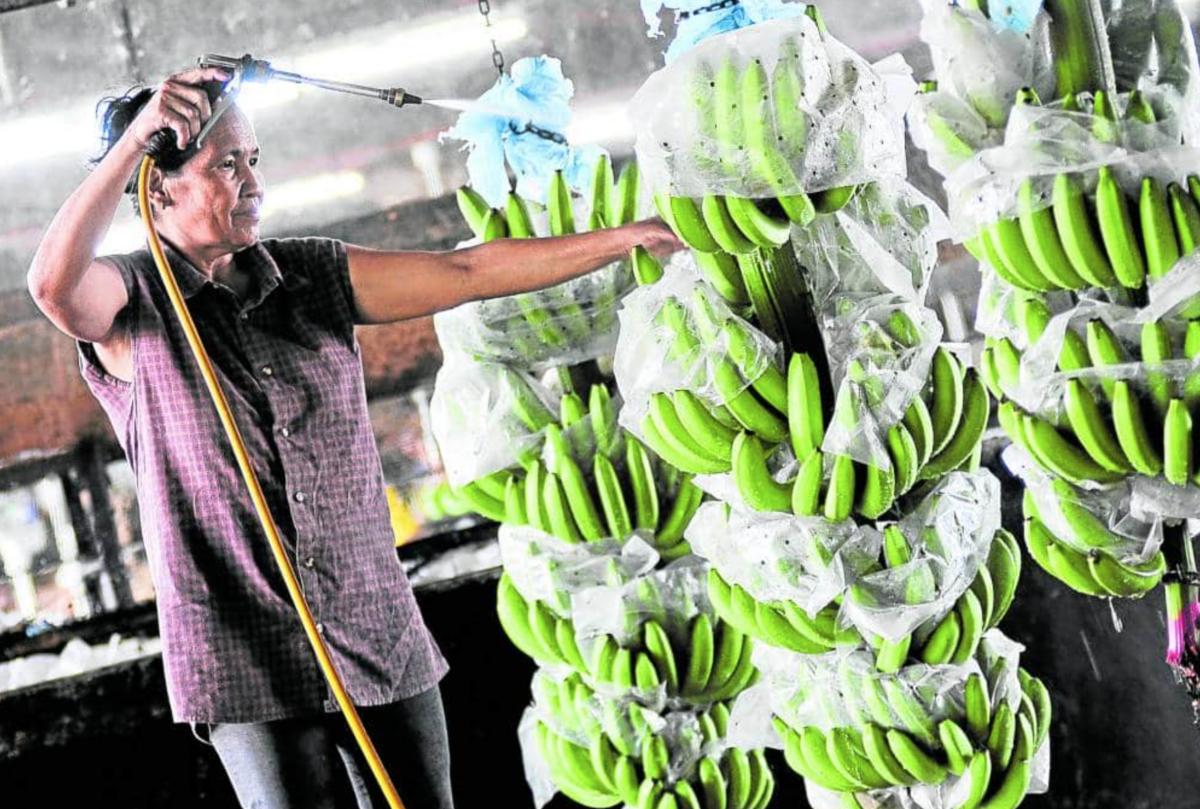
The Philippine government is working to expand market opportunities for bananas and other agricultural products in Asia and the Middle East, a government official said.
Gerald Glenn Panganiban, director of the Bureau of Plant Industry (BPI), said the agency was focused on boosting agricultural trade with South Korea, Japan and key markets in the Middle East.
“Aside from other Pacific countries, our focus is on countries [with existing market access]. We’ll just have to expand our commodity lines,” Panganiban said on Wednesday.
Panganiban said South Korea was open to importing singkamas or turnip, although the Philippines has not yet exported this commodity.
He said BPI would meet with producers next week to determine if they could cater to South Korea, which was interested in importing a specific volume of turnips.
“We’ll just have to check with our production areas if they can supply for that export market,” he said on the sidelines of the BPI’s 96th anniversary celebration in Manila.
Portfolio of fruits
The Philippines has market access in South Korea for fresh calamansi, dragon fruit and pomelo, according to BPI.
Panganiban said the deployment of an agricultural attache to the Middle East would enable the country to widen its market reach, citing the increasing Filipino population in the region.
Discussions are ongoing with various industry players in the Middle East to supply agricultural produce to supermarkets and chains in the region, including mango, banana and pineapples.
“We will have to look for stable markets (in the Middle East) so that we will not export in small quantities,” he said.
Meanwhile, Panganiban said BPI is optimistic about securing market access in Uzbekistan, among the country’s targeted nontraditional export markets, this year.
He said BPI would sign relevant agreement with its counterpart in the Central Asian nation by March or April covering fresh banana, pomelo, pineapple, avocado, mango and mangosteen.
“We discussed with the multinationals if it’s possible and they are saying there is a potential,” he added.
Trade data
Philippine agricultural trade had amounted to $2.44 billion in December, a 1.7 percent growth from $2.4 billion in the same month a year ago, data from the Philippine Statistics Authority showed.
Agricultural exports increased by 19.3 percent to $884.77 million, while agricultural imports fell by 6.2 percent to $1.55 billion.
This brought the farm trade deficit to $668.35 million, narrowing by 26.9 percent.
“We are now reaping the gains of our efforts to widen our menu of farm export products and open new markets,” Agriculture Secretary Francisco Tiu Laurel Jr. said last week.
Source: Inquirer.net
Share:


<p>Time: November 2025<br /> By: WTO and International Trade Group, Legal Department – VCCI</p>
