

As Phnom Penh and London seek to convert dialogue into deals, the success of their partnership will be measured not by the number of meetings held, but by the visibility of Cambodian products in UK markets and the scale of British investment contributing to Cambodia’s next phase of economic growth.
The growing economic relationship between Cambodia and the United Kingdom is increasingly being shaped by a shared commitment to long-term trade expansion, private sector engagement and strategic investment, with both governments signalling that bilateral commerce is moving into a more mature and forward-looking phase.
While the 3rd Cambodia-UK Joint Trade and Investment Forum (JTIF), held on Thursday, provided a platform for dialogue, officials on both sides stressed that the substance of the partnership now goes well beyond a single annual event.
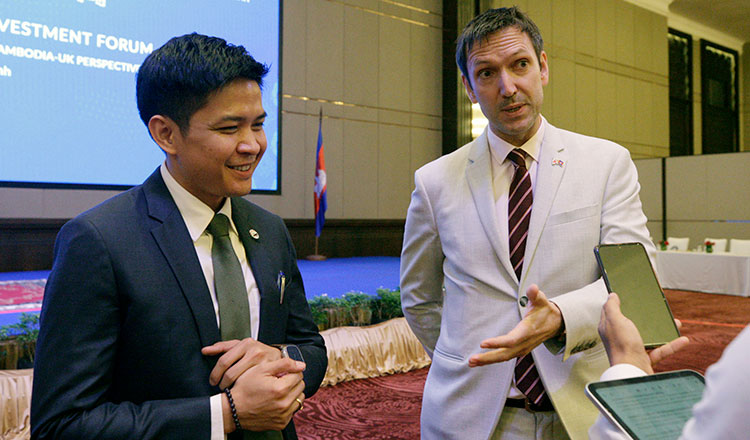
In an exclusive interview with Khmer Times conducted on the sidelines of the forum, British Ambassador to Cambodia Dominic Williams and Secretary of State at the Ministry of Commerce Samheng Bora outlined how the JTIF has evolved into a practical mechanism for translating policy alignment into tangible business outcomes, reflecting the growing importance of trade and investment in the broader Cambodia-UK relationship.
According to Ambassador Williams, the JTIF was conceived as part of a deliberate effort to deepen economic engagement following the first-ever visit to Cambodia by a UK Foreign Secretary, which created new momentum between the two countries. “The idea for the Joint Trade and Investment Forum was born during a visit to Cambodia by the UK Foreign Secretary at the time — the first such visit — which created momentum for deeper economic engagement between our two countries,” he said.
He noted that despite differences in economic size and development stage, Cambodia and the UK share a common outlook as open trading nations. “Although our development paths differ, we have both relied heavily on trade and exports to drive growth and deliver prosperity to our people,” he said, describing this shared perspective as a key foundation of the bilateral relationship.
From Cambodia’s standpoint, the value of the forum lies in its ability to connect policy with real-world commercial realities. Bora said the UK has long been one of Cambodia’s priority export markets, making structured engagement essential rather than optional. “Cambodia exports a significant volume of goods to the UK, which has remained one of our priority markets for many years,” he said.
He added that the JTIF allows both governments and businesses to gain clearer insight into each other’s priorities. “This platform allows the private sector to better understand government policies, while governments gain a clearer picture of the challenges businesses are facing on the ground,” Bora said, noting that issues raised since the first forum have been actively followed up through continued dialogue.
Trade data and export performance illustrate why the relationship is attracting growing attention. Cambodian exports to the UK have increased substantially in recent years, particularly in agricultural commodities such as rice. Bora attributed this expansion directly to the strong institutional support provided by the UK. “Trade growth with the UK has multiplied across several commodities, including rice, and this is a direct result of the strong and constructive relationship between Cambodia and the UK,” he said.
He stressed that this growth has been underpinned by concrete support mechanisms. “The various support mechanisms provided by the UK are extremely important. At the Ministry of Commerce, we have actively taken full advantage of these support systems, whether through trade facilitation programmes, capacity building, or direct engagement,” he said, adding that such assistance has helped Cambodian exporters diversify and scale up their presence in the UK market.
Beyond export volumes, access to the UK carries broader strategic significance for Cambodia’s trade ambitions. Bora described the UK as one of the most competitive and influential global markets, where entry often signals product quality and international readiness. He pointed to close cooperation with the British Embassy, the UK Foreign, Commonwealth and Development Office and the Department for Business and Trade, alongside other initiatives as key drivers supporting Cambodian firms and encouraging UK investment into Cambodia.
For the UK, Cambodia’s economic transformation presents a growing range of commercial opportunities, particularly for companies that may not yet be fully aware of the country’s progress.
“Cambodia is a fantastically exciting economy,” Ambassador Williams said, highlighting the country’s rapid development over the past three decades. “Over the last 30 years, Cambodia has built entirely new sectors—from manufacturing to export-oriented industries generating billions of dollars annually, creating jobs, and supporting education and livelihoods.”
He argued that the principal challenge is not a lack of opportunity, but limited awareness among British businesses. “The real question for me is not whether opportunities exist, but why more British companies are not yet fully aware of them,” he said. As Cambodia continues to diversify into areas such as automotive components, consumer electronics and services, the scope for UK expertise, technology and capital is expected to widen further.
Ambassador Williams identified education, infrastructure and financial services as three areas where cooperation is likely to deepen. He said British educational institutions already operating in Cambodia are contributing to skills development, while UK infrastructure firms have the experience to support projects that improve competitiveness by lowering energy and logistics costs.
Financial services, a traditional strength of the UK, could also play a growing role as Cambodia develops its capital markets and seeks greater access to international finance.
Both sides acknowledged that visibility remains a critical constraint on investment flows. Ambassador Williams said that while regulatory frameworks in fast-growing economies inevitably take time to evolve, regulation itself is not the primary barrier. “The real obstacle is awareness,” he said, noting that Cambodia and the UK lack a long shared commercial history, making trade promotion missions essential to introducing Cambodia to British firms.
Bora echoed, emphasising the importance of branding and proactive outreach. He said UK investors who engage directly with Cambodian authorities and learn about investment incentives, special economic zones and the Qualified Investment Project framework often express strong interest. However, without sustained promotion, many potential investors remain unaware of these opportunities.
On the trade side, he acknowledged that Cambodia’s exports remain concentrated in lower value-added sectors and face recognition challenges, particularly in agriculture. While Cambodian products are competitive in quality, stronger branding and market positioning are needed to differentiate them in the UK market.
Looking ahead, both leaders expressed confidence that the JTIF will continue to evolve as a driver of concrete outcomes rather than a symbolic gathering.
Ambassador Williams summed up the ambition in practical terms. “The raw ingredients — products, services, and opportunities — are already there,” he said. “The forum provides the process: aligning regulations, policies, finance, and awareness to turn those ingredients into something meaningful.”
As Cambodia and the UK seek to convert dialogue into deals, the success of their partnership will be measured not by the number of meetings held, but by the visibility of Cambodian products in UK markets and the scale of British investment contributing to Cambodia’s next phase of economic growth.
Source: Khmer Times
Share:

<p>Time: November 2025<br /> By: WTO and International Trade Group, Legal Department – VCCI</p>
