

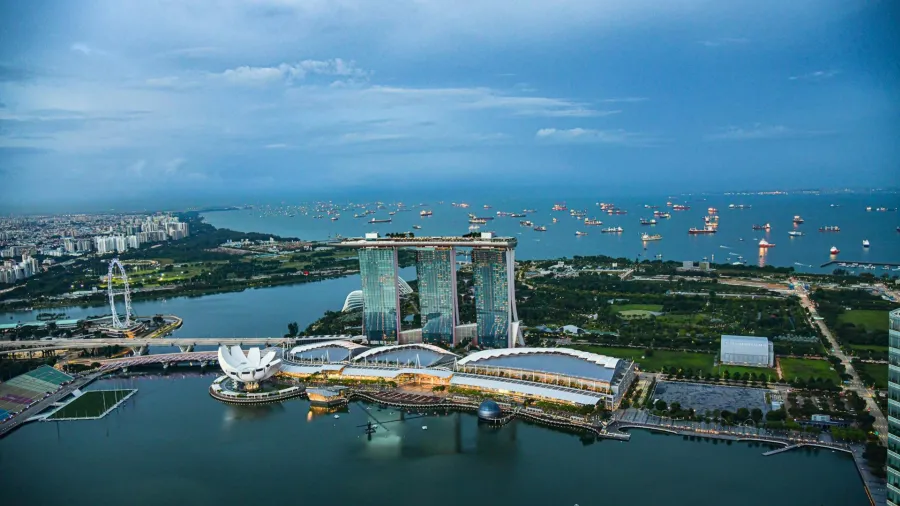
UOB flags GDP momentum fades after 2025 hit 5% full-year.
Singapore’s economic growth is expected to moderate to 2.6% in 2026, down from 4.8% in 2025, as base effects weigh on year-on-year (YoY) comparisons, UOB said.
"Our projections remain somewhat conservative. We expect a quarter-on-quarter seasonally adjusted contraction in the first quarter of 2026 after three consecutive quarters of strong growth, followed by below-trend momentum in the second through fourth quarters of 2026," the report said.
The bank noted that the positive output gap observed in 2025 could narrow, though real gross domestic product (GDP) would remain slightly above potential in level terms.
Following December’s industrial production data, UOB expects fourth-quarter 2025 GDP to be revised up to 6.5% YoY from the earlier 5.7% advance estimate, pushing full-year 2025 growth slightly higher to 5%.
Gains in 2025 were driven by front-loaded exports, strong semiconductor demand, and robust electronics NODX, with spillovers to wholesale trade and transportation & storage sectors.
UOB flagged that a significant macroeconomic shock, such as a geopolitical event or sustained weakness in economic data, could trigger a correction in US equities, potentially disrupting AI-related capital expenditures, supply chains, and labour markets.
This could precipitate a US-led recession with global spillovers, it said. Trade tensions also remain a concern. Recent geopolitical frictions over Greenland and newly announced US tariffs on advanced semiconductors highlight policy uncertainty.
The Ministry of Trade and Industry said that current tariffs have minimal impact on Singapore’s chip industry, though an expansion could pose risks to the sector.
On structural growth, UOB noted that Singapore’s potential GDP growth may have risen to 3–3.5% post-pandemic, supported by digitalisation and early AI adoption, compared with the previously cited 2–3% range.
The city-state’s 10-year average growth, excluding pandemic-related fluctuations, stands at 3.5%.
Leading indicators suggest AI-related demand could persist into the first half of 2026. Singapore’s electronics PMI rose to 50.9 in December, supported by higher new orders, employment, and order backlog.
Regional data points also show robust tech exports from Taiwan and South Korea, whilst major tech companies plan to expand data-center investments amidst chip supply shortages and rising prices.
In monetary policy, the Monetary Authority of Singapore (MAS) maintained the current rate of appreciation for the S$NEER policy band at an estimated 0.5% per year, with no changes to its width or center level, in line with Bloomberg consensus expectations.
MAS has opted to keep its policy unchanged in January’s review, maintaining the Singapore dollar policy band at its current level.
Zavier Wong, market analyst at eToro, said the move was “not much of a surprise,” noting that the central bank appears comfortable allowing the economy some breathing room.
Despite the steady policy stance, MAS now expects both headline and core inflation in 2026 to run higher than previously projected, even as current price pressures remain contained.
According to Wong, this combination suggests the central bank is “more comfortable with today’s conditions than with where inflation could settle further out.”
He said the revision shows underlying pressures remain strong despite softer headline numbers. Services costs are stable, wages are still rising, and domestic demand is steady.
A stabilising global tech cycle and resilient trade flows support the economy, suggesting no urgent need for policy relief, added Wong.
At the same time, MAS sees persistent inflation risks, which explains its upward revision to the 2026 outlook.
Wong said the unchanged policy keeps the currency stable for now but does not rule out future moves, noting that markets will watch upcoming inflation prints to see if pressures persist.
“The decision today signals some level of comfort with current conditions, but not complacency," he said. "MAS appears willing to wait, reassess, and adjust only if inflation proves more persistent than expected."
Source: Singapore Business Review
Share:

<p>Time: November 2025<br /> By: WTO and International Trade Group, Legal Department – VCCI</p>
