

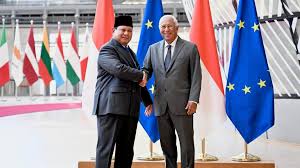
A diplomat representing the European Union (EU) has signaled that the bloc would review the possibility of a regional trade agreement with ASEAN after 2027 as smaller-scale accords take shape.
Over the past years, the EU has struck − or is nearing − trade deals with several ASEAN members. The question arises of whether Europe is considering having a regional trade deal with the Southeast Asian club.
EU Ambassador to ASEAN Sujiro Seam said on Monday, January 26, 2026, that the two blocs had agreed to make a region-to-region trade deal a “long-term objective”, but it might take some time before the negotiations can begin.
“In the meantime, we will focus on bilateral trade agreements between EU and ASEAN member states as building blocks [towards a regional one],” Seam said as quoted by Jakartaglobe.id.
The EU so far has secured three of these so-called “building blocks”. The 27-member grouping already has existing trade pacts with Singapore and Vietnam, respectively. The third one is a deal, dubbed the Comprehensive Economic Partnership Agreement (CEPA), with Indonesia, although this document still awaits lawmakers’ approval.
This accord still has to go through some legal processes before the tariff-free export for Indonesian goods can enter into force early next year. According to Seam, negotiations are underway for similar trade pacts with Thailand, the Philippines, and Malaysia. Seam looked back on EU trade chief Maroš Šefčovič promise to finalize the ongoing negotiations by 2027.
Earlier that day, Seam had said that the U.S. President Donald Trump’s imposition of heavy tariffs on Southeast Asian nations, on top of Washington’s aid withdrawal, had played in the EU’s favor. In April 2025, Trump unveiled a reciprocal tariff salvo with rates on ASEAN members that ranged between a staggering 49 percent to 10 percent. The import duty rates on some countries have dropped after countries rushed to appease Trump's tariff wrath.
The EU reported that its goods trade with ASEAN totaled EUR 258.8 billion (US$307.5 billion) in 2024. The European grouping had exported around EUR 94.3 billion worth of goods to ASEAN, while recording around EUR 164.5 billion in imports. Services trade volume reached EUR 132.1 billion in 2023.
At home, expectations are soaring high for the upcoming Indonesia-EU CEPA. Bilateral trade with the EU amounted to US$30.4 billion in 2024, data showed. Coordinating Minister for the Economy, Airlangga Hartarto, estimated that these numbers could “jump about 2.5 times within 4 or 5 years [of implementation]”. Business lobby group Apindo chairwoman Shinta Kamdani has also described the CEPA as a “great boon for diversification”.
Global trade shifts
Earlier on Monday, Seam noted that changes in United States trade policy under President Donald Trump have inadvertently strengthened the EU’s position in Southeast Asia.
In April 2025, the U.S. imposed steep reciprocal tariffs on ASEAN countries, with rates ranging from 10 percent to as high as 49 percent, alongside reductions in foreign aid. While some tariff levels were later adjusted following negotiations, the measures prompted ASEAN nations to reassess their external economic partnerships.
“ASEAN tries to keep a balance as it has to face a change of posture from the U.S.,” Seam said. “[ASEAN] wanted to keep the balance among its external partners. It didn’t want to hedge all bets on China. So naturally, it turns to other partners.”
Trade volumes
Trade relations between the EU and ASEAN remain robust. According to EU data, total merchandise trade between the two regions reached €258.8 billion (US$307.5 billion) in 2024.
EU exports to ASEAN amounted to €94.3 billion, while imports totaled €164.5 billion. Meanwhile, bilateral trade in services reached €132.1 billion in 2023.
In Indonesia, expectations are rising ahead of the implementation of the EU–Indonesia CEPA. Bilateral trade between Indonesia and the EU stood at US$30.4 billion in 2024, official figures showed.
Minister Airlangga has projected that trade volumes could increase by as much as 2.5 times within four to five years after the agreement takes effect.
Echoing this optimism, Indonesian Employers Association (Apindo) chairwoman Shinta Kamdani described the CEPA as a “great boon for diversification,” particularly as global supply chains continue to shift amid rising geopolitical and trade uncertainties.
Source: Indonesia Business Post
Share:

<p>Time: November 2025<br /> By: WTO and International Trade Group, Legal Department – VCCI</p>
