

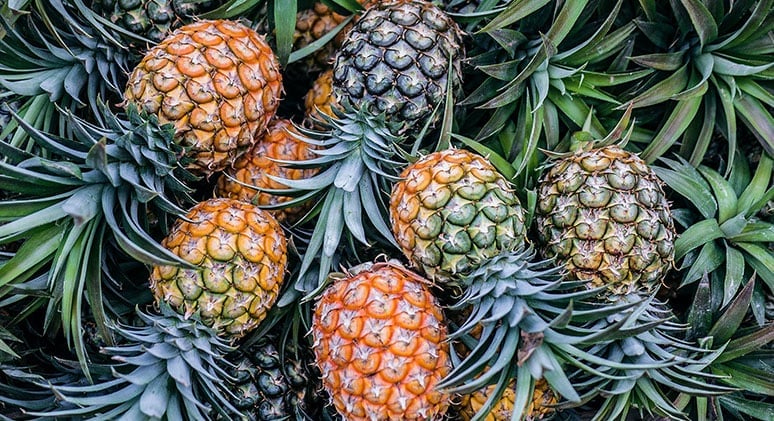
By 2025, Malaysia's pineapple exports are projected to reach 1.4 billion ringgit (approximately US$298 million), with a total export volume of 76,000 tons
The Malaysian government aims to increase pineapple export value to 2 billion ringgit (approximately US$425 million) by 2027, as part of a strategy to strengthen the industry – which is being positioned as a high-value agricultural commodity.
Malaysian Deputy Minister of Agriculture and Food Security Datuk Chan Foong Hin said that the pineapple industry has the potential to generate an income of approximately US$1,915 per hectare per month for growers through the application of modern farm management practices.
In 2025, Malaysia's pineapple exports are projected to reach 1.4 billion ringgit (approximately US$298 million), with a total export volume of 76,000 tonnes to markets such as the Middle East, China, and Europe. According to Deputy Minister Chan, pineapple exports are expected to continue expanding thanks to the exploration of new markets, including New Zealand.
“The visit to the MD2 pineapple planting project in Sungai Gumut is part of the government ’s efforts to promote the development of the pineapple industry. We aim to further increase export value and reach $425 million by 2027,” Mr. Chan told reporters after his visit to the Sungai Gumut Pineapple Collection Center.
The MD2 project is operated by Premium Pineapple Sdn Bhd, covering a total area of 109.26 hectares. Currently, 16 hectares have been planted, equivalent to 740,432 MD2 pineapple plants, with a reported survival rate of over 97%.
Mr. Chan said the visit also marked the groundbreaking ceremony for the construction of a collection, processing, and packaging center. This facility is expected to support the pineapple industry's value chain from production to market.
He also emphasized that Selangor state has many favorable conditions to develop into a modern agricultural and food center, thanks to its logistics infrastructure such as airports, seaports, and railway networks, along with continuous policy support from both the federal and state levels.
"We not only want people to buy pineapples to eat, but we also want this area to become a hub for processing, packaging, branding, and export activities, including the development of high-tech processing plants and agricultural tourism potential," said Mr. Chan.
To support the development of the pineapple industry, the Malaysian Pineapple Industry Council has provided seedlings and agricultural supplies worth approximately US$47,200, a grant of approximately US$6,380 for farm shops, and technical advice. In addition, there are community and youth-oriented programs such as Inisiatif Pendapatan Rakyat and Agropreneur Muda.
Looking ahead to 2026, the Council plans to launch another development project in Selangor covering 49 hectares, with a total support budget of approximately US$277,000, and is expected to attract the participation of 26 producers. In the previous year, approximately US$38,300 was allocated to young farmers in the state through the Muda Agropreneur Support Program, now renamed Agropreneur NextGen.
Mr. Chan added that the Selangor State Government has also allocated approximately $24,100 to pineapple farming businesses, while in Hulu Selangor, an agricultural supplies support package worth over $255,000 has been granted to 38 production units.
“The Federal Government and the Selangor State Government will continue to strengthen strategic cooperation with the Malaysian Pineapple Industry Council and the private sector to develop the pineapple industry in a sustainable manner, while reinforcing national food security,” Mr. Chan emphasized.
Currently, Malaysia supports over 8,000 growers and more than 300 companies involved in pineapple cultivation, ranging from small to large scale. The country reports a pineapple self-sufficiency rate of 103%, creating favorable conditions for both the domestic and export markets.
Advances in agricultural technology, such as the use of drone technology, have helped farmers double their income, as evidenced by one farmer in Johor who increased his annual income from RM180,000 to RM350,000 (approximately USD39,000 to USD76,000).
As for Viet Nam, in the landscape of agricultural exports, pineapple is emerging as a product with great potential, both in fresh and processed forms. With favorable climate, soil conditions, and rapidly increasing global demand, Vietnamese pineapples are poised for a breakthrough, aiming for a billion-dollar market share.
By the end of May 2025, Vietnamese pineapples were present in more than 100 countries and territories. The largest market was the European Union (EU), followed by the United States.
Viet Nam currently has approximately 52,000 hectares of pineapple cultivation, of which 48,000 hectares are already producing fruit, with an average yield of 184.1 quintals/hectare and an annual production of over 860,000 tons. The target for 2030 is to reach 55,000-60,000 hectares with a production of 800,000-950,000 tons. Key provinces include Ninh Binh, Thanh Hoa, Quang Nam, Tien Giang, and Kien Giang.
With its existing foundation and significant potential, Vietnamese pineapples are at a favorable time to reposition their role in the structure of agricultural exports, not only increasing production but, more importantly, enhancing their value.
Share:




<p>Time: November 2025<br /> By: WTO and International Trade Group, Legal Department – VCCI</p>
