

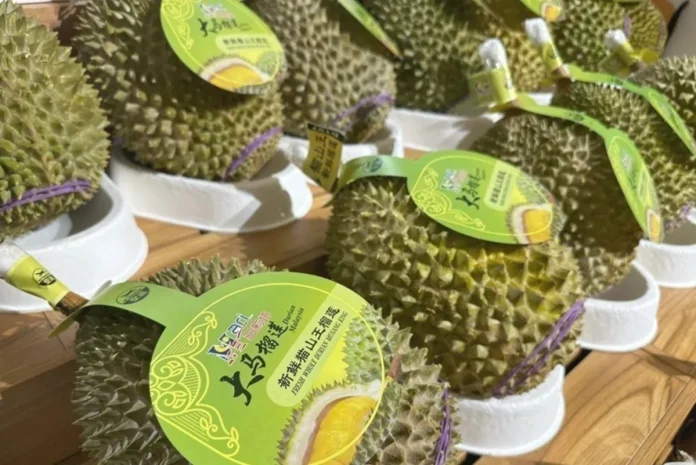
The recent entry of Laos into China’s lucrative durian market is set to intensify competition for Malaysian exporters, particularly on pricing and logistics, but analysts say Malaysia’s premium durian segment is likely to remain resilient if quality and branding are preserved.
The development marks a shift in competitive dynamics within Asean, as Laos leverages lower production costs and a direct rail link to China to reduce shipping time and expenses, potentially undercutting suppliers that rely on air freight.
Associate Professor Dr Fazleen Abdul Fatah of Universiti Teknologi Mara said Laos’ lower land and labour costs, coupled with the China-Laos Railway, could exert downward pressure on durian prices, though mainly in the mass or mid-range segment.
“Lower production costs in Laos could create price pressure, but not necessarily for Malaysia’s premium varieties,” she told SunBiz, noting that Malaysia’s durian exports, particularly Musang King, operate in a distinct high-end market segment.
She added that Malaysian Grade A durians exported to China can command prices three to four times higher than lower-grade fruit, supported by strong branding, flavour profiles and varietal identity.
“As long as Malaysia maintains strict quality control, credible traceability, consistent grading and certification such as MyGAP, its premium positioning can remain intact,” she said, cautioning however that premium status is not guaranteed if quality consistency weakens or supply reliability falters.
China’s durian demand remains vast, with imports reaching more than 1.56 million tonnes in 2024. While Laos has set a modest export target of 400 tonnes, representing less than 0.03% of China’s total imports, its entry adds to growing competition from Thailand and Vietnam.
Prof Paul Teng Piang Siong, visiting senior fellow at the ISEAS-Yusof Ishak Institute, said Laos’ geographic advantage could allow it to take some market share from Malaysia if quality expectations are met.
“Laos has the advantage of direct land transport to China, which reduces shipping costs, shortens transport time and helps maintain freshness,” he said, adding that lower labour costs further strengthen its position.
However, he stressed that Laos’ advantage hinges on whether its durian varieties meet the taste and quality expectations of Chinese consumers.
“Ultimately, fruit quality will determine how much market share Laos can realistically capture,” he said.
On food security, Teng noted that durian is not a staple crop and therefore poses little risk to Malaysia’s national food security.
“Durian is more of a luxury item, so the overall impact on Malaysia’s food security is minimal,” he said, though he cautioned that lower earnings could affect household food security for durian growers without diversified income streams.
Looking ahead, Fazleen said rising regional competition underscores the need for Malaysia to rethink its long-term agricultural export strategy, particularly for high-value crops.
“In the past, gaining access to China’s market was itself a major advantage,” she said. “Today, access alone is no longer enough.”
She said Malaysia’s strategy would likely centre on geographical indication protection, premium branding and positioning its durian as a tree-ripened, high-quality product, akin to how consumers differentiate Wagyu beef from standard beef.
Productivity gains and technology adoption will also be critical in offsetting higher domestic costs, she added, highlighting precision fertilisation, smart farming, improved pest management and post-harvest technologies such as cold-chain logistics and digital traceability.
Teng echoed this view, saying any technology that reduces production costs, increases yields and preserves freshness would strengthen Malaysia’s competitiveness, while stable pricing contracts could help smooth out volatility.
On the demand side, Teng said Chinese consumers remain drawn to both Thai varieties such as Monthong and Malaysian premium cultivars including Musang King, Black Thorn and D24, but are still price-sensitive.
“Durian has a special appeal because of the unique flavour of each variety,” he said, adding that sustained marketing campaigns in China would be essential to reinforce Malaysia’s premium image.
Both experts also pointed to the importance of diversifying export markets beyond China to manage long-term risk. Dr Fazleen noted that Malaysia currently accounts for only about 3% of global durian exports, suggesting significant untapped potential in markets such as Taiwan, the Middle East and Latin America.
“Diversifying markets and expanding value-added durian products will be critical for long-term resilience,” she said.
Source: The Sun
Share:


<p>Time: November 2025<br /> By: WTO and International Trade Group, Legal Department – VCCI</p>
