

It was welcome news when the Board of Investment (BoI) announced a sharp rise in investment applications in 2025.
From January to September, requests for investment promotion surged by 94% year-on-year, reaching a record 1.37 trillion baht. The figure marks the highest level recorded, underscoring Thailand's appeal to investors and the country's ability to attract capital even amid global economic uncertainty.
Yet beyond Thailand's borders, the BoI faces stiff competition in its goal to host Southeast Asia's most attractive investment hub.
Viet Nam has become a rising star, drawing foreign capital at an accelerating pace and reshaping the regional investment landscape.
Hanoi has promoted investment to strengthen its economy and expand export capacity. The strategy has paid off, with foreign firms, including Thai companies, steadily increasing their presence in the country year after year.
The momentum is based on manufacturing, tourism, infrastructure and demographics, which together create a powerful growth engine.
The Explainer takes a closer look at whether Viet Nam is emerging as an economic rival to Thailand, why it has captured the attention of global investors, and how Thai businesses are responding to the shift.
Is Viet Nam's rapid growth a concern for Thailand?
Thailand cannot afford to ignore Viet Nam's momentum, said Jongjarern Jomjakra, assistant chairman of the Thai Chamber of Commerce and Industry in Viet Nam (ThaiCham).
Viet Nam's government set an ambitious target of 10% annual GDP growth by 2030, after recording an estimated 8% expansion in 2025. In 2024, Viet Nam's GDP ranked fourth in Southeast Asia, trailing only Indonesia, Thailand and Singapore.
The country is positioning itself as a high-tech manufacturing hub, with bold ambitions to become a regional centre for semiconductors, said Mr Jongjarern.
Heavy investment in infrastructure is part of the plan to transform Viet Nam into a high-income economy by 2045. In comparison, Thailand's infrastructure development is often viewed as lagging, raising concerns the country could lose ground in attracting new industries, he said.
Lower labour costs and a younger workforce tilt the scales in Viet Nam's favour. With an average age of 33, Viet Nam's "golden population" contrasts sharply with Thailand's ageing workforce, where the average age is around 40.
This demographic advantage gives Viet Nam a stronger base for long-term growth, while Thailand faces mounting challenges as it has become an aged society.
Tourism adds another dimension to the rivalry. Viet Nam has stepped up efforts to increase foreign arrivals by subsidising flights, improving airport infrastructure, and diversifying destinations beyond Hanoi and Ho Chi Minh City, said Mr Jongjarern.
These moves are designed to draw tourists away from Thailand, which has long been the region's tourism powerhouse, he said.
This shift pressures Thai destinations to innovate and adapt, whether by enhancing cultural experiences, expanding eco-tourism, or improving service quality, said Mr Jongjarern.
Why is Viet Nam's economy expanding so quickly?
The roots of Viet Nam's transformation lie in the Doi Moi reforms of 1986, which shifted the country from a centrally planned economy to a socialist-oriented market economy, he said.
By opening up to private enterprise, foreign investment and global trade, Viet Nam set itself on a path to become one of Asia's fastest-growing economies.
That policy stability continues to inspire confidence. In 2024, Viet Nam attracted US$38 billion in foreign direct investment, compared with $32 billion for Thailand, Mr Jongjarern said.
The country has agreed to more than 60 free trade agreements, giving investors tariff-free access to global markets and making Viet Nam a highly competitive destination for expansion.
Viet Nam's government also sets clear long-term goals. Beyond GDP growth, it prioritised industrial upgrades, infrastructure modernisation and human capital development.
The push to become a semiconductor hub reflects Viet Nam's ambition to move up the value chain, while investments in roads, ports and airports are designed to support both manufacturing and tourism, he said.
Another factor is Viet Nam's ability to leverage its youthful workforce, Mr Jongjarern said.
The country has a ready supply of workers for industries ranging from textiles to electronics. This demographic dividend is expected to last for decades, giving Viet Nam a sustained advantage over Thailand, where labour shortages are becoming more pronounced, he said.
Are Thai companies expanding businesses into Viet Nam?
Thai investment in Viet Nam has grown by an average of 20% annually, with businesses of all sizes seizing opportunities across multiple industries, said Mr Jongjarern.
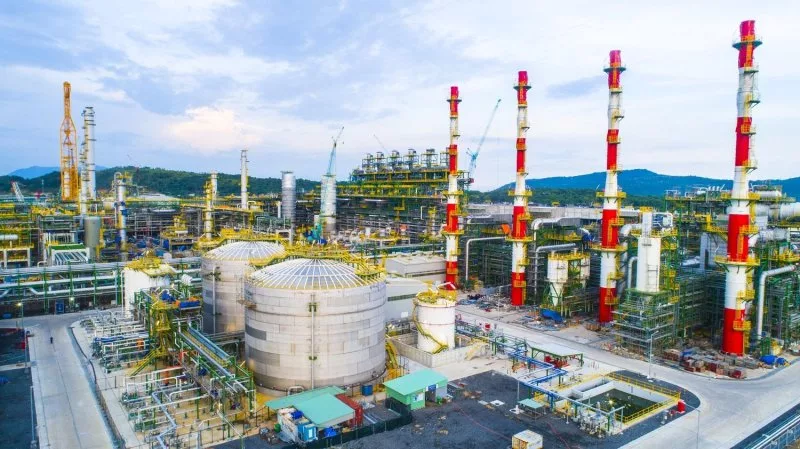
One of the most prominent examples is SCG Chemicals, a subsidiary of Siam Cement Group, which operates Viet Nam's largest petrochemical plant -- Long Son Petrochemicals (LSP).
The facility is expected to produce 1.4 million tonnes of petrochemical products annually, meeting Viet Nam's surging demand for plastics and positioning SCG as a key player in the region.
Other Thai firms are investing in renewable energy, food processing, cars and auto parts.
ThaiCham notes Viet Nam still offers a wide range of untapped opportunities, particularly in infrastructure development. Projects involving electricity, water supply and road construction remain in high demand as the country continues to push forward with its modernisation agenda.
"There are investment prospects for Thai businesses across many sectors in Viet Nam," said Mr Jongjarern, adding the environment is ripe for both large-scale ventures and smaller initiatives.
To support this momentum, ThaiCham has been working with investors, signing memorandums of understanding to encourage cross-border cooperation, hosting business forums, and facilitating direct meetings between Thai companies and Vietnamese officials to strengthen ties and promote new ventures.
Source: Bangkok Post
Share:


<p>Time: November 2025<br /> By: WTO and International Trade Group, Legal Department – VCCI</p>
