

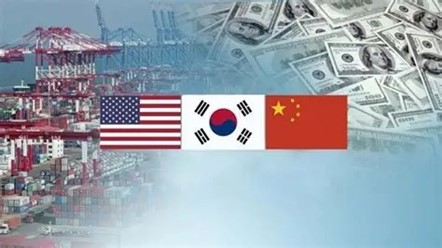
Exports to China drop by 20%; US, ASEAN see growth by 28.2% and by 12.5%, respectively
Due to factors including the US containment of China, exports to China plummeted by approximately 20% over the past five years (2021-2025). During the same period, exports to the US increased by 28.2%, while ASEAN and Viet Nam grew by 12.5% and 10.8% respectively, clearly demonstrating South Korea’s export diversification trend.
An analysis of the Ministry of Trade, Industry and Energy’s export-import trends from 2021-2025 conducted on Jan. 2 revealed that South Korea’s exports to China decreased by 19.7% over the past five years.
Exports to China recorded $162.9 billion in 2021, then plummeted to $155.8 billion in 2022 and $124.8 billion in 2023, and partially rebounded to $133 billion in 2024 and $130.8 billion in 2025, but failed to recover to previous levels. The overall downward trend continues.
By product category, structural changes in exports were more pronounced. Last year’s exports to China showed decreases in traditional mainstay products compared to the previous year: petrochemicals $16.27 billion (-6.6%), wireless devices $7.33 billion (-6.5%), and general machinery $6.28 billion (-62.8%). This is interpreted as the result of China’s rapidly growing manufacturing capabilities intensifying competition with South Korea’s key industries.
Although exports to China decreased significantly, the sluggish performance in Chinese exports did not immediately translate into an overall decline in total exports.
Last year, South Korea’s exports recorded $709.7 billion, setting a new all-time record. This resulted from semiconductors entering a super cycle due to artificial intelligence (AI) and data center expansion, while the US, ASEAN, and Vietnamese markets substantially absorbed the decrease in Chinese exports.
Particularly, exports to the US surged 28.2% over the past five years, from $95.9 billion in 2021 to $122.9 billion last year. With the US imposing mutual tariffs and supply chain restructuring taking effect, assessments suggest this trend may continue for some time.
Notable regions include ASEAN (Association of Southeast Asian Nations, including Thailand) and Viet Nam.
ASEAN exports increased 12.5% over the past five years, from $108.8 billion in 2021 to $122.4 billion last year. During the same period, Viet Nam also grew 10.8% from $56.7 billion to $62.8 billion.
This appears to be due to increasing cases where Chinese companies, facing difficulties in direct exports to the US due to regulations, are establishing factories in Viet Nam or ASEAN to conduct indirect exports to the US and EU. This is attributed to the expansion of core intermediate goods and parts supply as factories concentrate in Viet Nam, where major domestic companies such as Samsung Electronics and LG have established operations.
Although global economic growth is expected to slow this year due to US mutual tariffs and supply oversupply from China, analysis suggests that Southeast Asian exports remain competitive. While there are many variables, Southeast Asia’s low production costs including labor expenses may limit the impact of global economic growth slowdown, and the proportion of Southeast Asian export industries is expected to increase significantly.
Meanwhile, Latin America increased from $25.8 billion to $31 billion, and the European Union (EU) grew from $63.6 billion to $70.1 billion. The Middle East increased from $15.6 billion to $20.4 billion, and India grew from $15.6 billion to $19.2 billion respectively.
Source: Business Korea
Share:



<p>Time: November 2025<br /> By: WTO and International Trade Group, Legal Department – VCCI</p>
