

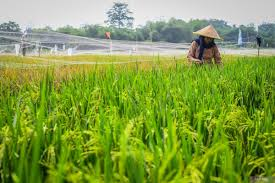
The Indonesian government has just made an important announcement regarding national food self-sufficiency, deciding not to import any rice in 2026.
This statement was issued following a recent inter-ministerial coordination meeting in Jakarta, attended by senior leaders from the Ministry of Food Security Coordination, the Ministry of Trade, and the Indonesian Statistics Agency. At the meeting, Mr. Tatang Yuliono, Deputy Assistant Coordinator for Trade and Distribution at the Indonesian Ministry of Food Security Coordination, emphasized that all domestic needs, from rice for household consumption to rice for industrial production, will be met by domestic supply.
Notably, the Indonesian government has firmly rejected a proposal from the Ministry of Industry to import nearly 381,000 tons of rice for industrial purposes next year, believing that domestic production is fully capable of supplying factories by 2026. Mr. Tatang also emphasized that Indonesia will not allow the import of rice for household consumption.
This policy is strictly enforced nationwide, including in free trade zones such as the Sabang region in Aceh province. To reinforce this roadmap, relevant ministries will continue to hold commodity balance meetings to thoroughly review food import and export policies for the coming period.
Indonesia's confidence in implementing a policy of saying no to imported rice stems from its remarkable achievements in 2025, when the archipelago nation will completely cease importing both rice and corn, thereby achieving a crucial goal in ensuring national food security.
By mid-2025, the state's rice reserves had reached a record high of approximately 4 million tons, the highest figure in the country's history. Remarkably, this entire quantity was produced domestically. This abundant reserve not only helps stabilize the market but also plays a crucial role in providing relief to people in provinces affected by natural disasters and floods.
Indonesia's agricultural sector has been driven by a combination of favorable weather conditions and a comprehensive farmer support system implemented by President Prabowo Subianto's administration. According to statistics, rice production in 2025 is estimated at 34.77 million tons, an increase of over 13% compared to the previous year. This result is due to the government's proactive efforts to stabilize procurement prices, making rice farming profitable and encouraging farmers to remain committed to their fields.
In addition, corn production has also recorded impressive figures, with expected output reaching 4 million tons by the end of 2025, ensuring supply for both domestic food needs and the poultry industry.
In the long term, Indonesia is not only focusing on rice and corn but also setting higher goals in its food self-sufficiency strategy. Under the leadership of the new government, the country is actively applying advanced technology to farming, attracting highly skilled young workers, and expanding agricultural land on the island of Kalimantan.
After successfully resolving the rice issue, the Indonesian government's next goal is to eliminate dependence on imported white sugar by 2026. Simultaneously, the Ministry of Agriculture is focusing resources on increasing domestic production of soybeans and wheat, commodities that remain heavily reliant on external sources.
Source: VTV
Share:


<p>Time: November 2025<br /> By: WTO and International Trade Group, Legal Department – VCCI</p>
