

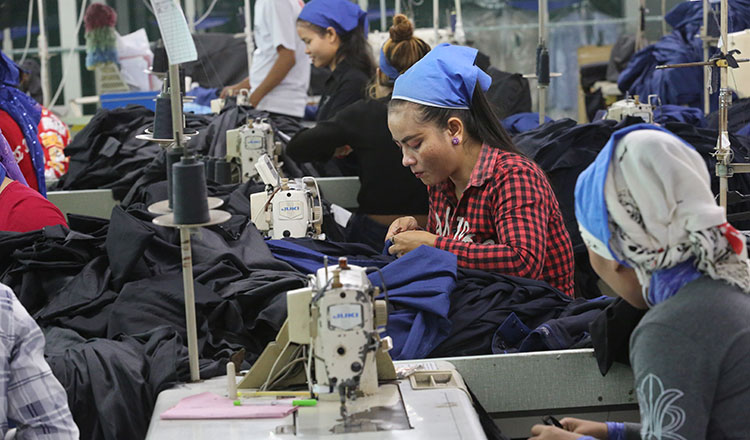
Arresting the declining trend for most of the last 18 months, the exports of garments, footwear and travel goods (GFT) rose by 22.22 percent in the first two months of this year, compared to the same period last year, earning the Kingdom $1.89 billion.
The turnaround brought cheers to the vital sector of the Cambodian economy that employs nearly one million people, as this could put a halt to the loss of jobs and closure of garment factories.
According to the latest trade data released by the General Department of Customs and Excise (GDCE), all segments under the GFT sector performed well in the January to February period of 2024, raising their exports, compared to the same period last year.
Accordingly, the exports of knitted apparel articles and clothing accessories earned $842 million, registering a growth of 24.5 percent, compared to January-February 2023. Non-knitted apparel articles brought in $527 million with a growth of 29.7 percent year-on-year.
Footwear exports earned $225 million in the first two months this year, an increase of 11.5 percent year-on-year, and articles of leather and travel goods another $268 million with a growth of 11.3 percent over the same period.
Other made-up textile articles earned $33,647 in the first two months of 2024, registering a growth of 31.9 percent, compared to the same period last year.
In February 2024 alone, the GFT exports earned the country $930 million, a rise of 22.83 percent, compared to February 2023.
According to Massimiliano Tropeano, Sustainability and Garment Expert of the European Chamber of Commerce in Cambodia (EuroCham), there is “good order visibility till June-July” for the sector, indicating that the rising trend in exports will continue in the months ahead.
“The buyers maintained a very low buying profile last year trying to sell all the old stock accumulated. This new season saw the big American and European buyers placing back orders in a normal way. There seems to be a portfolio of orders’ visibility that extends till June-July 2024,” Tropeano said.
The Sustainability Expert, however, suggested a couple of measures to increase the sustainability and competitiveness of the sector in Cambodia. “While the situation might seem good on the order side, the garment industry is going through a lot of struggles and also facing fierce competition from Bangladesh and Vietnam. On the sustainability side, despite the efforts of TAFTAC and EuroCham, there is the concrete fear that the new compensation tariff for the solar rooftop system will be so high that it can disrupt not only the old investment financial balance but also completely shut all the new planned private solar rooftop investment in the country,” he said.
Ken Loo, the Secretary General of the Textile, Apparel, Footwear & Travel Goods Association in Cambodia (TAFTAC), told Khmer Times yesterday that the sector is on the path of recovery as demand is rising. “It seems we hit rock bottom last year,” he said, indicating that the worst may have been over.
The GFT sector is one of the biggest employment generators in the country and has created nearly one million direct jobs, according to the International Labour Organisation (ILO). The sector accounted for 11 percent of the economy and contributed around 50 percent of Cambodia’s real GDP growth as per its estimates in 2021.
It may be recalled that Cambodia’s GFT exports declined by 13.31 percent in 2023 amidst global challenges, from $12.80 billion earned in 2022 to $11.09 billion, leading to the suspension of work for many factory employees.
The decline in GFT goods exports that started in the latter half of 2022 continued last year too even as almost all other sectors registered growth in exports in 2023.
The Cambodian government in March 2023 started providing an allowance of $40 a month to each worker in the GFT sector whose labour contract was suspended following the slowdown in global demand. This was in addition to the $30 to be given to each suspended worker by the factory management.
Source:Khmer Times
Share:


<p>Time: November 2025<br /> By: WTO and International Trade Group, Legal Department – VCCI</p>
