

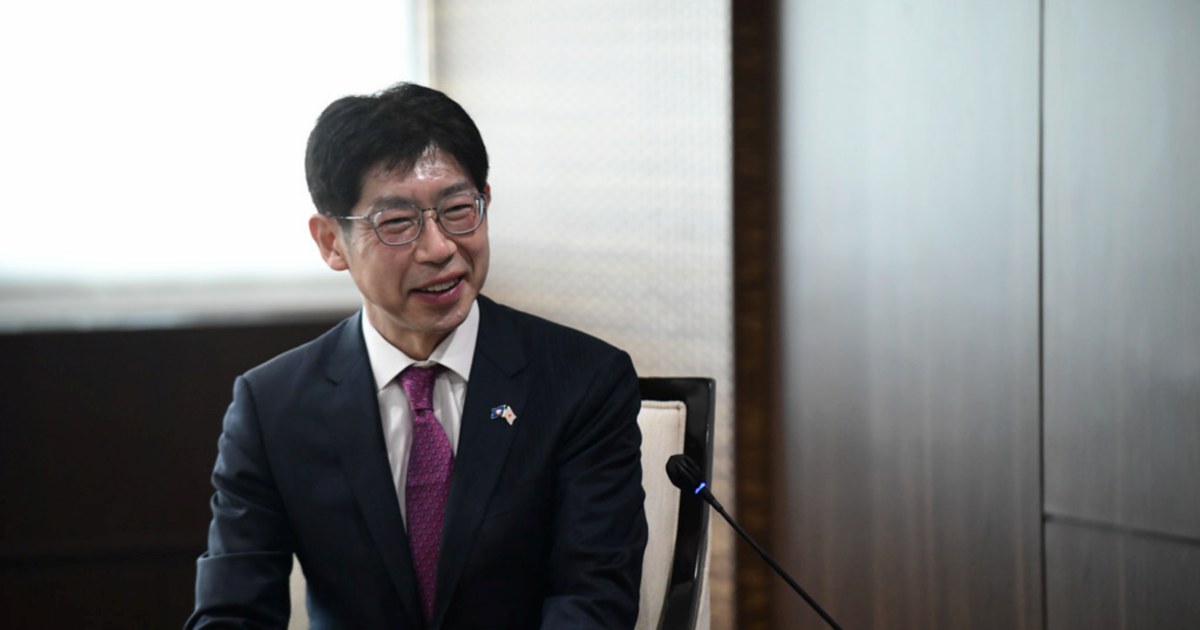
The Japanese government views the Association of Southeast Asian Nations (ASEAN) as a crucial strategic partner in the Indo-Pacific region, and the Japanese ambassador to ASEAN outlined the country’s next priorities in a speech at a regional forum.
This year marks the 50th year of ASEAN-Japan friendship and cooperation. In the past five decades, the two have been partners. It all started in 1973, when ASEAN was united to address the issue of the growing export of synthetic rubber from Japan. The dialogue turned out to be the very first successful experience of ASEAN’s external engagement.
In the decades that followed, the two partners have achieved numerous achievements, including the ASEAN+3 Summit, the ASEAN Coordinating Centre for Humanitarian Assistance, the “Chiang Mai Initiative”, the Japan ASEAN Integration Fund (JAIF), and the Economic Research Institute for ASEAN and East Asia (ERIA).
Addressing participants in the 12th ERIA Editors’ Roundtable held in Jakarta, Indonesia, on Wednesday last week, Kiya Masahiko, Ambassador of the Mission of Japan to ASEAN, said ASEAN is and always has been a key partner of Japan in the region of the Indo-Pacific.
“ASEAN will continue to be important for Japan. ASEAN is in a strategically important location, the centre of the Indo-Pacific region, enjoying a growing economy with a population of 670 million as the centre of global growth and becoming a multi-layered regional cooperation hub such as ASEAN Plus Three, the East Asia Summit, and the ASEAN Regional Forum,” he said.
He added that Japan promotes peace, stability, and prosperity in the Indo-Pacific, the ASEAN Outlook on the Indo-Pacific (AOIP) and Free and Open Indo-Pacific (FOIP) and shares fundamental principles, including openness, transparency, inclusiveness, and respect for international law.
“On emerging cross-cutting global issues, including but not limited to energy, decarbonisation, the circular economy, digital transformation, health, ageing, and well-being, disaster management, ASEAN and Japan can co-create solutions,” Kiya said.
Kiya also announced two important steps that Japan aims to take jointly with ASEAN to bring their cooperation and partnership for the good of common interest to another level.
“First, ASEAN and Japan should co-create practical solutions under AOIP,” he said. “For practical cooperation, the Government of Japan has already announced several concrete initiatives.”
Kiya gave two examples of such an act. During the announcement of the New Plan for FOIP in March, an additional $100 million to the Japan-ASEAN Integration Fund was announced.
On the occasion of the ASEAN-Japan Summit in September, the Japan-ASEAN Comprehensive Connectivity Initiative was also released.
“Second, ASEAN and Japan should continuously promote exchange for “heart-to-heart” relationships to deepen and expand our mutual trust,” Kiya added. “For the youth, more than tens of thousands of youth exchanges have been achieved through JENESYS (Japan-East Asia Network of Exchange for Students and Youths) and SSEAYP (Ship for Southeast Asian and Japanese Youth Programme), and this year we launched a new exchange initiative for young business leaders, namely the ASEAN-Japan Young/Generation Z Business Leaders Summits.”
“We also promote the exchange of scientists and researchers through JASTIP (Japan-ASEAN Science, Technology and Innovation Platform) and AUN/SEED-Net (ASEAN University Network/Southeast Asia Engineering Education Development Network). These connections are fundamental for co-creating practical solutions and a multicultural society.”
Already, a number of important commitments have been made and deliverables announced to promote ASEAN-Japan cooperation throughout this year. Meanwhile, in December, the ASEAN-Japan Commemorative Summit will be held in Tokyo, and ASEAN and Japan plan to adopt a new Joint Vision Statement and its Implementation Plan to set out directions for the partnership in the coming decades.
Kin Phea, director-general of the International Relations Institute at the Royal Academy of Cambodia, said Japan and ASEAN have a “huge space” for cooperation in the Indo-Pacific.
“The FOIP has been well-received by the ASEAN member states, while in 2019, ASEAN itself adopted the AOIP to guarantee that the ASEAN countries will enjoy benefits from and coordinate the initiatives in cooperation with partners in the region, especially Japan,” he explained. “It is necessary that all initiatives have to be complementary in nature, which means each partner has its interests to follow.”
Phea added that developing countries in ASEAN, including Cambodia, will be able to benefit from the economic gains through investment and trade, while the “transfer of technology” as part of the investment and product use will allow those nations to develop more rapidly.
Dr Lam Peng Er, a Principal Research Fellow with the East Asian Institute at the National University of Singapore, told Khmer Times that ASEAN should follow an “inclusive” policy by welcoming the small, middle, and great powers as its partners. The core message of what he said could be best described as “ASEAN-centred multilateralism”.
“What we don’t want is unilateralism by any individual great power or being caught in a bipolarity,” he explained. “ASEAN must also solidify its ties with Japan, Australia, South Korea, India, and other rising powers. There’s no alternative to that.”
Source: Khmer Times
Share:


<p>Time: November 2025<br /> By: WTO and International Trade Group, Legal Department – VCCI</p>
