

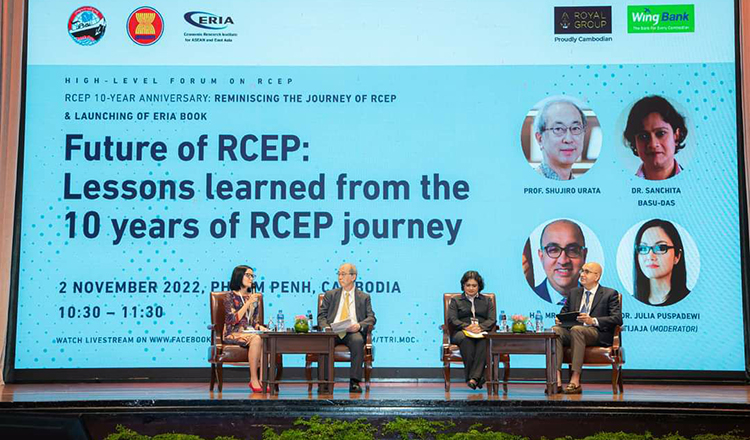
The 10-member Association of Southeast Asian Nations (ASEAN) will continue to be the driving force for the Regional Comprehensive Economic Partnership (RCEP), said Dato Lim Jock Hoi, the Secretary General of Asean, recently in Phnom Penh.
While taking part in a high-level forum to commemorate the 10 years of RCEP, the Secretary-General said Asean had to take the role of a moderator many times during the negotiations for the regional trade agreement in the past and this role was key to the successful signing of the pact.
“Often the FTA partners took care to understand the Asean stand before making their stand clear,” Dato Lim Jock Hoi said while reminiscing the hectic days of the negotiations for the RCEP pact.
Asean, now, has to maintain this leadership role during the implementation stage of RCEP as well, he said.
According to him, this role of Asean, in fact, is not limited to the region. The regional grouping has to play a crucial leadership role in resolving the current geopolitical issues. “Only Asean can provide a platform for solving the current political and economic issues rattling the world. It can be the bridge. The centrality of Asean is crucial for such initiatives,” he noted.
On the issue of India joining the RCEP, Dato Lim Jock Hoi said the door is still open for the country. “There are many factors, but the important fact is that India has not closed the door yet. India can come back anytime when it is comfortable,” he said.
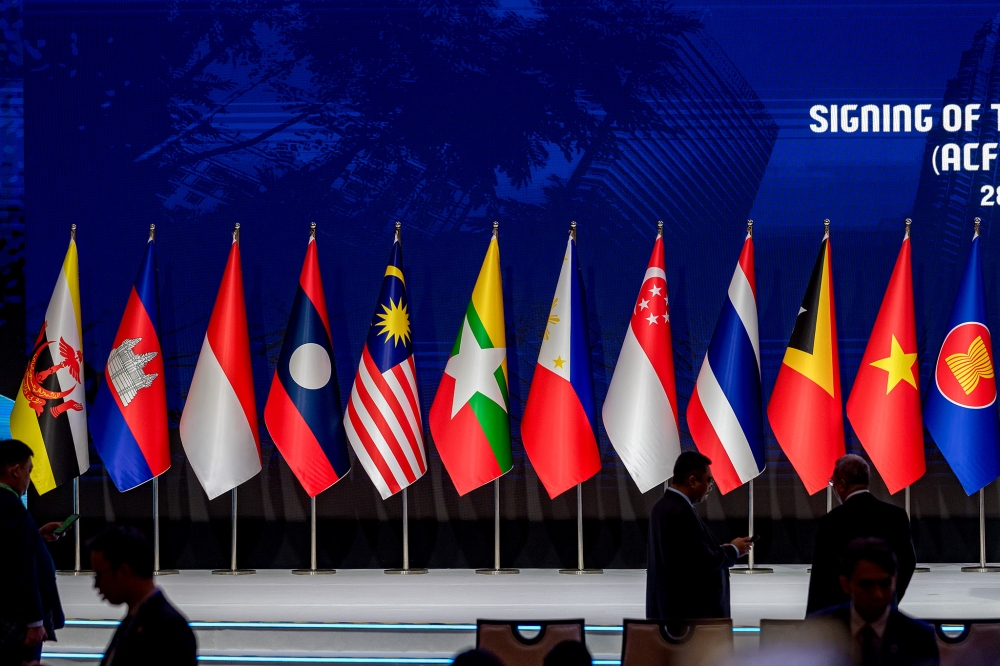
The 15 signatories of RCEP include the 10-member Asean plus China, South Korea, Japan, Australia and New Zealand. India which was a party to the negotiations in the initial years suspended the talks later but never shut the doors completely.
Meanwhile, Shujiro Urata, Advisor to President of Economic Research Institute for ASEAN and East Asia (ERIA), said RCEP played a big role in the region for bringing back the economies to the path of recovery from Covid-19. “This role should continue for the future economic growth of the region as well. For this, implementation of the commitments given by the partner countries is important,” he said.
Economist Sanchita Basu-Das pointed out that any trade agreement has winners and losers and partner countries of RCEP should take care to compensate the losers. All partner countries also need to adopt respective national action plans to align with the regional policies of the pact, she said.
Sanchita also stressed the need to have forward-looking policies in RCEP with regard to digitalization and e-commerce.
Satvinder Singh, the Deputy Secretary-General for ASEAN Economic Community, called for having “an investment pool to boost the capacity of individual countries to implement the RCEP provisions smoothly.”
The RCEP member countries are at different levels of development and their capacities to implement the provisions are also different, Singh pointed out. “RCEP cannot ignore the huge challenges such as digitalization and sustainable development,” he reminded.
“It is also very important that the member countries focus only on the economic benefits of the agreement. RCEP should not be converted as a platform for pursuing geopolitical strategies,” Singh said.
He also stressed the need for engaging the private sector. “All businesses in the region including the SMEs should be encouraged to make use of the platform,” he said.
The RCEP, according to Singh, has started showing the results. “Our economies are doing better. All major international companies now want to engage with RCEP,” he said.
The forum was jointly organised by Cambodia’s Ministry of Commerce along with ERIA and the Asean Secretariat.
Source: Khmer Times
Share:
<p>Time: November 2025<br /> By: WTO and International Trade Group, Legal Department – VCCI</p>
